Monday, July 28, 2014

Summer reading-- quick reviews of six books

Murphys, Ca -- Between travel and hot afternoons I have been reading a lot of different  books in the past few weeks, most of them older books. Some were fun reads, some challenging and a couple were disappointing. Here's how I reacted:


"Bad Monkey" by Carl Hiaasen:

This is Carl's 23d book,  his 14th novel, so he must be doing something right.
 His hero has the usual fun attributes: bad employment history; raging hormones; hatred of the people who have destroyed Florida as he knew it; disrespect for authority, and an inner quality and honesty that makes you like him.
In this book it is a failed detective-turned-food-inspector who spots a murder no one else sees, and pursues it despite various bosses and killers trying to stop him.
The setting is Florida and the Bahamas, territory Hiaasen knows and describes well, and just romping along with him is fun no matter where the story goes.
I thought this book was a little less edgy than earlier works, but it still will keep you up late at night or glued to the beach chair till the very end, which is never the ending you expect. A good read, full of murder, sex sand greed as always, from a truly gifted writer. Four out of five stars.

"Rainbow Pie" by Joe Bageant

This is a non-fiction look at social class in America -- mostly telling us why the author thinks poor Southerner white people are the way they are. (I meet two of the three categories, so consider this acknowledgment of my bias.)
The book blurbs call it "touching" and "majestic," but the book bogs down almost immediately and becomes a series of well written anecdotes spaced out by long rants about how unfair life can be and you just don't understand my people.

His focus in on what he calls "the white underclass," and there certainly is such a thing, but he doesn't make a compelling case that poor whites are all that different from all other poor people.

He mixes colorful stories of his upbringing in a Scots-Irish family in the early 1950's in West Virginia, and the writing in excellent in short bursts. He is very angry at our leadership, and the way it has damaged the country and its people-- opinions I happen to share.
But then what? Then he starts telling us what  he thinks it all means, which is mostly opinion without any clear support.
A good friend liked this book and thought it had something important to say. I thought it was mostly a waste of ink and paper, and I sure hope no one thinks this is the definitive work on the culture of the South, or white people, or anything else. This is a person with writing talent who needs to focus on clarity. Two of five stars.

"Death of a Doxy" by Rex Stout


                                         Argosy Magazine illustration

This was one of the Nero Wolfe mysteries written in the 1960s I ran across in a used book store. Narrated by his witty and flirtatious sidekick Archie, and full of the usual Nero Wolfe stuff, this is a well-told tale about a murder. But in this case the accused is one of Wolfe's regular private detective employees, so they have to prove him innocent and do it in a clever way that will allow Wolfe to collect a large fee without compromising his honesty. He is a clever fellow.
Stout died 40 years ago, and his books are still enjoyable, weaving stories in a captivating way and rarely giving away the end until -- you guessed it -- the end. If you are a Nero Wolfe fan, this is a five star production.

"Shattered" by Dick Francis

This mystery by Dick Francis was originally published in 2000, and joins the long list of entertaining mysteries he wrote through the years.  His great talent seems to me to be writing in an easy style that always teaches you about something you did not know -- in this case glass art blowing and manufacturing -- and pitting a fairly ordinary person against truly bad people.
This is a complex book, taking you through art galleries and horse tracks, dealing with rich aficionados and racetrack thugs, all in search of a video tape the hero is supposed to have, but doesn't.   Along the way we learn how to blow glass artwork, what sells and what doesn't, and how dangerous the tasks can be. Horses are in the background.
 There's a hint of romance but the book is more about solving the puzzle and good people versus bad people.  Five stars.


"The Making of Yosemite: James Mason Hutchings and the Origin of America's Most Popular National Park" by Jen A. Huntley


This is a book I had been watching develop for almost a decade. I knew it was being written through historian friends in Yosemite, some of whom helped the author with her research. I  always found Hutchings to be a fascinating and somewhat overlooked character in the history of the park,  collected material on him at one time and looked forward to someone providing insight into what must be a complex person.
I am still looking for a good book on the man. You won't learn a lot about him in this book, but you will know what the author thinks it all means.
As the over-long title suggests this is a screed that reads like a defense of the graduate thesis that started the author on the way to the book. Here it is spelled out in the book flap: "...Hutchings was effectively written out of its(Yosemite's) history, and today he is largely viewed  as an opportunist who made a career out of exploiting Yosemite."
Only he wasn't, and isn't, in my opinion. He was apparently an odd person, but he made a lot of friends and influenced a lot of people, but not much money.
Hutchings, a prolific author in his day, is widely known as the first person to expose Yosemite to the world's view, a major accomplishment in his day. He did this by taking artists and writers and influential people into Yosemite, even when it was an arduous trek. He personally published magazine articles and books. Almost all the early drawings and paintings of Yosemite Valley are directly as a result of his effort to bring influential people to the Valley. For almost 25 years he personally appeared in most of the photographs of the park, because he led the photographers on their journeys and happily posed on horseback or in a boat on the river when they needed a human model. He ran a hotel, and fought the state (and lost) over his right to own the land under it as a settler, but he is mostly remembered as a writer  and promoter who opened Yosemite for the nation to see.
 I would argue, having read a lot about Hutchings from other sources, that the claims are mostly wrong and this tedious book doesn't prove much of anything.
The author uses Hutchings to argue about the clash of "class dynamics" in the 19th Century.  According to this book he "framed the debate" that led to the national park system and the way we see it today.
She did a lot of research, and had access to a lot of primary materials including Hutchings' diaries.
And yet you don't learn much about him, you simply read a lot of intellectual arguments about the meaning of everything that happened -- without much factual data to back it up.
I suspect this book was briefly popular with academics who specialize in California and Yosemite.  The respected California historian Kevin Starr  wrote a jacket blurb calling the book "innovative in its interpretation." I've loved Starr's writings, but I was disappointed.
In really want to know what kind of a person Hutchings was, what he did and what conclusions we might draw.
That book has yet to be written.
Two stars, because it may be useful to cultural anthropology students who need this sort of analysis.


"Pleading Guilty" by Scott Turow (1993)

Turow uses  the law, finance, and fascination set of imperfect characters to tell a really good story.
The main character is a rough-around-the-edges former cop turned attorney who his given the assignment to locate a missing law partner and $5 million or so that has disappeared.
The maneuverings within the law firm to avoid responsibility for anything, while maintaining a proper public face, provides the hero (or anti-hero) a free field for chasing down the presumed bad guy, not to bring him to justice but to avoid embarrassment for everyone and protect their incomes.
The hero falls off the wagon, and into bed with a partner, and then he has to face the choice of doing the right thing, or not.
Therein lies the tale, and it is well told so I won't give it away.
Four stars


Saturday, July 5, 2014

A cooling off trip

Murphys, Ca -- Back home in time for the Fourth of July, and 100 degree heat, I need to share a few items from our recent vacation trip to the California coast.
If you have not been to this part of the world, it is hard to imagine the variety and the beauty of the coast. That's true north and south, but for this trip we went first to the San Francisco Bay area for some sailing, and then drove north for a week or so of camping with friends and family.

Here's a rare photo of s/v Good News with Oakland in the background, heading out for the bay. It turned out to be a lot windier than we expected, so it was more exciting than planned.


The next day I decided to pull down a sail that needed minor repair, and replace it. Bad decision, as we ended up with a jammed halyard that I will have to fix next time.


I did not get our boat problem fixed, but I was able to help out a neighbor who cranked me up his/her mast to retrieve a loose shackle and lanyard. It is easy: all you do is sit in the Bosun's Chair while someone else does all the hard work. Easy in a calm harbor, that is. The top is about 50 feet up.
---
We then drove north on Highway 101, aka the Redwood Highway, and made an overnight stop at  Richardson Grove State Park, along the Eel River, the first test of our new "instant" tent. It worked fine and the next day we drove on up through Coastal Redwood forests and along the coast to our destination: Patrick's Point State Park, where we settled in for almost a week with family and friends.

Here's Pat enjoying a bit of sunshine at our campsite. Just beyond the trees on the right is the top of the bluffs overlooking the Pacific Ocean, a place we visited for sunrises and sunsets.

 This is the view from just south of the camp area, looking north into the little harbor at Trinidad. Picturesque, and fully equipped with good clam chowder and colorful people.

Pat with daughter Ruth on a hike. The extended family present included 18 people! Ruth and Brian and their kids, Brian's folks and sister Tammy and her kids, his cousin and his family, and our friends and neighbors Gary and Jeri Carson Hull.

Just another stunning view.

Jeri and Gary, probably looking for the warm sunshine.
Agate Beach at the state park. Yes, you can find and bring home agates. 

On the way to and from Oregon we stopped by a meadow at Prairie Creek State Park to share a lunch and watch the elk. The new babies were gamboling on the meadow. Really.


And then to the southern Oregon coast. This is at, you guessed it, Arch Rock, just north of the California border.

Our next-to-last night was spent at Gold Beach, Oregon, where our room balcony overlooked the Rogue River very near where it meets the sea.

We drove through the Trinity Alps area, including Weaverville, spent one night in a so-so motel, and got home about ten days after we left.

The views were obviously spectacular, but the best memories are of the family and friends we were with, the new people we met and simply being together in a wonderful place and time.

We did have one serious discussion with Gary and Jeri, trying to decide what we are vacationing from, since we are retired. Gary suggested we were vacationing from volunteering, which is probably as good an answer as any other.


Tuesday, January 21, 2014

Congress can change, really!

another century, similar views -- from the Library of Congress


Murphys, Ca  -- About the only thing U.S. citizens agree upon these days is that Congress is awful.
Not as in “awe-inspiring,” but as in “terrible.”
Congress is less popular than the media.
Congress is even less popular than the President.
We all have different reasons for disliking Congress, or our congressional representative, but at least we can all agree they collectively do a lousy job.

So, I think it is time to reform Congress, and it should not be too hard to do. Change a few laws.  Change a few rules.

Here are a few ideas and reforms that kept me awake last night, and I would appreciate it if you who read this will take the time to express your opinion, either in the comments section below, or on Facebook, or on a local soap box. Just speak up.

1.  Let’s get serious about time limits for the House and Senate. I propose two four-year terms for House representatives, and two six year terms for the U.S. Senate.  These suggestions are not unique: President Eisenhower begged us to make this change as he ended his tenure in office. He cited the same reasons we would:  every congressman is always running for reelection and therefore does not devote time and energy to the job at hand. They are too busy pandering to would-be voters to do what is right and necessary.
You can pick your own example, but there are many. We have way too many old white guys (like me) making decisions. Let the younger folks have a shot.

2.  Change the congressional pay to be less of an incentive. Today the House members get a base salary of $174,000. The average U.S. wage earner makes $44, 321.67. Let’s give them the benefit of the doubt and  pay them twice what most of use make: around $88,000 per year should be about right. (The first representatives got $6 a day, but only for days they worked.) You may have noticed that Congressmen are mostly rich, averaging a million dollars a year from private and public sources. That’s one reason they don’t act like normal people.

3. We want our elected officials to reflect us, right? So let’s limit the trappings of power that we now spend billions on. Start by limiting every representative to one secretary/administrative assistant, and one staff member, and one taxpayer funded office in Washington and one in the district.  You will note that I have eliminated every “spokesman” we now pay with tax dollars. Let the congressmen we elect speak for themselves.
Have you ever asked your congressman how many people work for him?
Has he ever answered you?

4.  Require representatives to actually work five days a week, 48 weeks a year. I’d be generous and give them the 4 weeks vacation, so long as they pay for travel and accommodations  themselves. That means they have to keep office hours either in Washington or at home districts, just like normal people.

5. Ban all gifts worth more than $25 to  representatives, and staff. They don’t need all those freebies and it looks bad. Stinks, actually.
6. We all understand that running for office takes money, and since we want to be fair, let’s have the same rule apply to all officials: contributions can come from anywhere so long as they do not exceed $25 and the name and employer of the donor are public record.

7. Congressmen complain that they have so little time and so many people want to see them, so let’s help them by setting a rule that says the priority for an appointment goes to a person from their district, second priority to individuals from their state, and last priority to representatives of corporations or organizations (we call them lobbyist).  And to make everyone have a chance, let’s limit all visits to 30 minutes for people they represent, and 15 for lobbyist, whether they are from the corporate timber company or the Sierra Club. Fair's fair.

8. Congressmen need a travel allowance (they actually have a generous one already), so we will let them keep enough to pay for four trips back to the district every year, but ban anyone else paying for or providing transportation. No corporate jets. No limos in New York City. No trips to ski resorts or Hawaii for “consultations.”

9. No relatives on the congressional payroll, any time, anywhere.

10. Since our elected officials are working for our interests, and we are paying them, we need to make sure everything they do while in office is open and visible to the public. That means all correspondence (national security is exempt) is available, all meetings are logged and subjects disclosed, and if minutes are kept, they should be made available to the public, at a charge not to exceed the per page cost at the closest Kinko print shop. Yes, that means e-mails and Facebook postings when done on government time.


This list could go on and on, and surely you have some ideas of your own. Feel free to add them, or challenge these.


Saturday, September 14, 2013

Serendipity


Murphys, Ca --  After 16 days on the road, and about 2,400 miles, we have re-learned an old lesson.

Do not over-plan. The best things happen when you just let them happen. 

That does not mean we did not know where we were heading, sort of. But stuff happens.

We knew we were going sailing with friends on San Francisco Bay. We knew we were going to see son Zack and grand-daughter Katie in their new home in Olympia. We knew we were heading for parts of British Columbia we had not seen before. And we knew we wanted a chance to sit down with old friends in Seattle before heading home. We did all that, and more.

Pictures are worth a thousand words, so here goes.

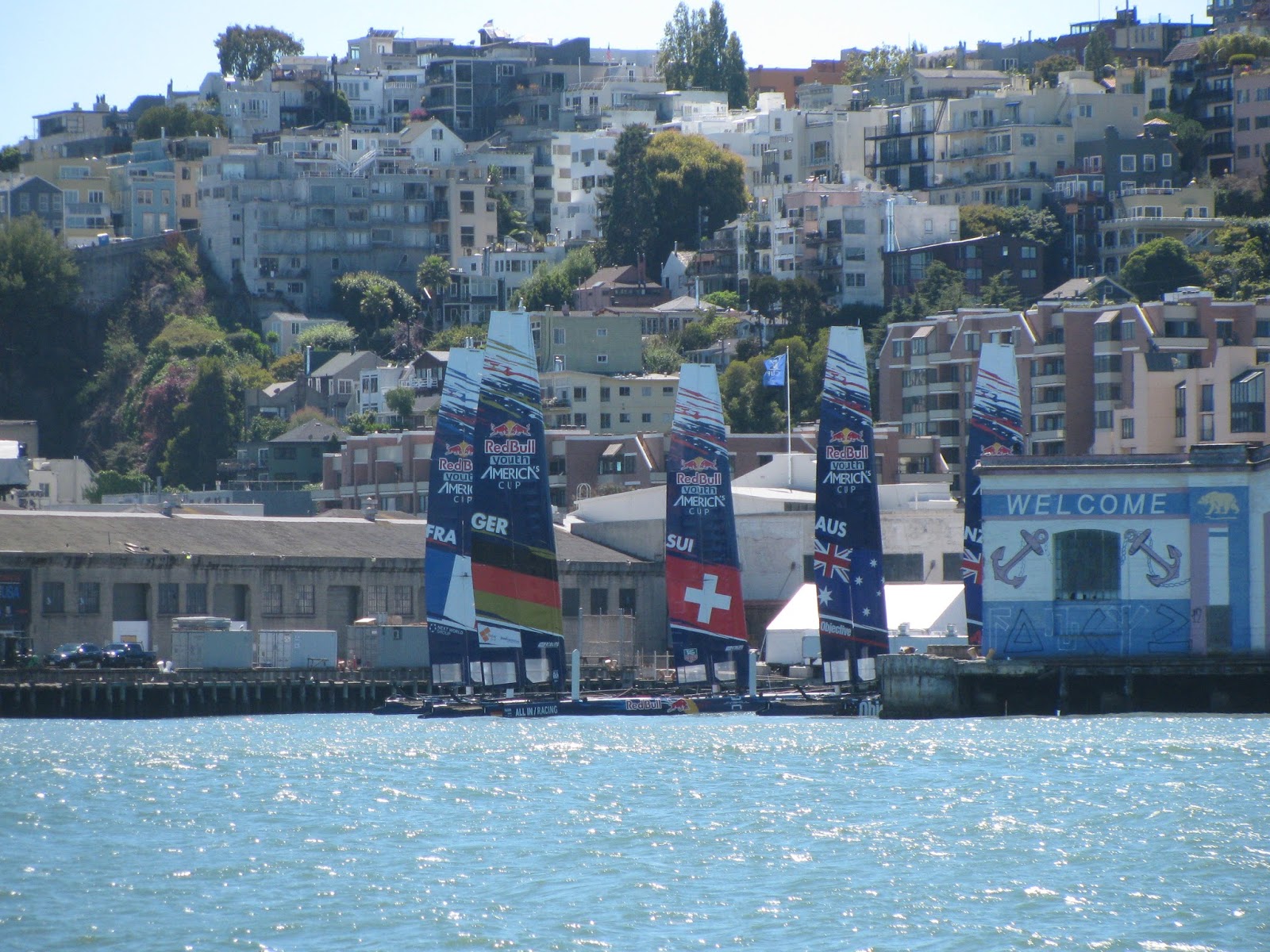
First two days we were sailing on San Francisco Bay during America's Cup prelims

 We expected to have nice sailing days with friends, but didn't know we would get up close and personal with America's Cup Oracle boats and the 42-foot Red Bull competition. Then it was on to Olympia.


Days 3, 4 and 5: Granddaughter Katie and son Zack hamming it up
Zack and Katie have a new home and apartment, and are surrounded by friends. She started her new high school and was excited about it. They showed us their new town and were the perfect hosts. Then we were  on the road north to Canada.

Day 7: Arriving at Nanaimo BC by ferry from Tsawwassen

We spent a night in Bellingham en route to Canada, crossed the border in plenty of time to catch the Tsawwassen ferry that takes folks and vehicles across to Vancouver Island. It is the only way to travel, and a delight. By chance we decided to head north on Vancouver Island and find a place to camp for a couple of days.


Day 8: Pat studies the flora, or fauna, or something
 The beach at the provincial park where we stayed was several miles long with tidal flats and rock and driftwood everywhere, overlooking the straits of Georgia. Very few people. Just us and the birds.

Day 9: Beach at the Provincial Park where we camped. Pat with birds and beach.

Our campsite was within walking distance of the beach. The place was clean and well run.

While there we heard a man talking about how beautiful the Pacific Rim Park area is on the western side of Vancouver, so we changed our mind about going further north and crossed the mountains to the West and landed in an area right out of a movie set.

Day 10: Our first look: Ucluelet Yurt living requires minimal activity


Also on day 10, we took a hike near Ucluelet to see the coastal area


Day 11: Pat reads instructions on yurt living
On the first day we took a hike near Uclelet, right on the Pacific coast. Local folks were disagreeing over what type of whales we were seeing. We did not care. The next day we went up to Tofino.
Day 11: Tofino, as far as you can drive in northwest BC
In Tofino, north of our private beach, we found picturesque views, lots of great places to eat local seafood, offers of tours to see bears and whales,  and an end-of-season fair/market where we bought photographs of wildlife.

Then it was heading south again, aimed for Victoria -- one of the most beautiful cities in North America, and a taste of the English-styled Canada.


 Lunch!
 This  dockside cafe just happened to be along the way to Victoria. More great seafood and scenery, near Salt Springs Island.

On to Victoria.


Day 13: Victoria is a beautiful blend of old English stuff and First Nation art and atmosphere. 


In Victoria we managed to get slightly lost in traffic, but found our way to the harbor and the center of the city. We stayed here once before on a boat, a great memory. It is a great city, and the new Bateman Center in the old Steamship Building is host to some glorious nature art. We found it while looking for a bathroom. More serendipity. That afternoon we boarded the ferry for the trip back to the U.S.

Day 13: Learning to park on a ferry from Victoria to Port Angeles can be a challenge. That's us on the left.
We took the ferry across Juan de Fuca to Port Angeles, then another ferry across Puget Sound to Edmonds north of Seattle for a visit with our fellow fellows from the class of 1978 at the University of Michigan.

Journalists never really retire, they just get together to talk about the good old days, how much fun we had, and how blessed we are by friendships.


Day 14: The Pike Street Market in Seattle, one of our favorite spots. We are in front of the brass pig.


Day 14: Marsha gives me a lesson in eating smoked salmon, while Warren records the moment.


Day 14: A perfect end to to a perfect day: dinner on Puget Sound with old friends.


Warren and Marsha, friends for 36 years, were the perfect hosts in Seattle. Years ago they interviewed us about having children: we had two and they had none at the time. They went home and had two beautiful daughters, both grown now. We've shared a lot through the years and miles, and we are better for having known them.

After two great days and nights, we loaded the car one last time and headed south on Interstate 5. Homeward bound. By the end of the first day we were very tired of driving, and looked for just anyplace to stay. We found this spot in Southern Oregon.


Day 15: The last night on the road at Wolf Creek Inn, Oregon
The Wolf Creek Inn is a restored 1880's travelers inn, run by the state of Oregon. The place once was a major stop for people going from the Oregon Trail to California. Still is.
Our room was furnished with antiques, the dinner was superb, and we even ran into people with whom we share mutual friends. More serendipity.


Day 16: Homeward bound with Shasta in sight

I believe this is in Northern California, somewhere near Weed, and we headed home on the final day. If it turns out t be Mount Ranier, or Lassen, I am truly sorry, but I am a bit tired.

I've refilled the bird feeders, been to my favorite bakery for a morning treat, and we are back in touch with home.

Tonight we work -- a pleasure really -- at a Habitat for Humanity Fund Raiser.

Home is good.

-------------------------
To misquote someone: "It's not about the destination. It is about the journey."

And, one last sunset....

Sunset at Wya Point on the Canadian coast


Sunday, September 8, 2013

Cool nights in Canada - Beauty all around us

The view from our Yurt at Wya Point
Ucluelet,  Vancouver Island, British Columbia -- We are in the land that no one can pronounce.
Well, that’s not entirely true. The First Nation people who live here, and the frequent visitors seem to manage quite easily.

The community of Ucluelet, for example, is called “Uke” for short. But the native name for it is “Yuul?il?ath.”  Pronounce the question marks as a  consonant in the roof of your mouth and you can come close.

We are deep into our vacation, 1,200 miles north of smokey Murphys, staying in an oceanside Yurt at  Wya Point. We are staying on native treaty lands just outside the  Pacific Rim National Park.  The resort town of Tofino is a few kilometers north. This is a far west as you can get in this part of Canada, and there are no roads to the north. They use boats and planes.
During a short hike we enjoyed hearing Canadian tourists arguing over the whales we saw were Orcas or Grey Whales. Matters not to us.
This area was inaccessible for most people until a road was built across the island of Vancouver in the 1950s. Now it is a sought-after resort area, mostly campgrounds and surfers, hikers and kayakers, but with a distinctive native chill out  ambiance.
Pat reads the "welcome" book at the Wya Resort yurt

The Ucluelet First Nation people have lived here for 7,000 years, and through a treaty they have taken control (regained?)  600 acres of old growth  rainforest on the edge of the Pacific, the almost forgotten Pacific side of Vancouver Island.

No casino here, just a beautiful place, well cared for where guests are welcomed. To quote the welcome page in our yurt: “The yurts are a part of a First Nation cultural destination resort ...

The Yuul?il?ath cultural connection to the land means that sustainability  is the guiding principle for all aspects of Wya Point development..”

Everything is made from local products, including the cedar floors in the yurts, and the  nearby lodges have earned a LEED Platinum award. That means it is very green.

That also means the showers and toilets use non-potable water, limited electrical power from battery kits and generators, and drinking water is hauled in every day.

But that allows us the privilege is being nestled into the edge of the cedar rain forest overlooking  a beach. At sunset last night a big crowd of maybe 8 or ten people were visible. 

My photos cannot do this place justice, but it gets two thumbs up, more if I had them.

Meanwhile,  here are a few local names to consider: Amphitrite is the lighthouse; Du-Quah is the native art gallery, Otalith is the local music festival, Cynamocka is a road, Ukee Scoops is the ice cream parlor, Kwisitis is the Feast House Restaurant located on  Wickaninnish Beach, popular with surfers but with miles of sand and driftwood that no one comes near.


You get the idea.

So, Nuu-cha-nulth
(Take Care and Thank You).


From the beach


A two-person Yurt, with deck and million dollar view, cost us $113 a night

Sunday, July 28, 2013

More music is always a good thing

Murphys, Ca -- Most of my friends know I like many different kinds of music. If I play, I keep it simple (folk and bluegrass and gospel). But I love listening to almost everything (except obscene rap and acid rock).

So the following is an announcement I put together for one in a series of concerts I am helping encourage at our little church.  If you are nearby, come see us and hear some fine musicians next Saturday.


    Murphys, Ca -- The Delphi Trio, the ensemble currently in residence at the
annual Bear Valley Music Festival, will present a free concert this coming
Saturday (Aug. 3) at 3 p.m. in the sanctuary of the historic First
Congregational Church in Murphys.

Trio individual members have performed in 14 countries and on four
continents, including as a trio in Europe, California and the Midwest. The
Delphi Trio has completed artistic residencies at the Dakota Sky
International Piano Festival, the Banff Centre for the Arts, and is
currently featured as artists-in-residence at Old First Concerts in San
Francisco where they have juxtaposed classic repertoire and works
commissioned for them.

Members Liana Be'rube', Michelle Kwon and Jeffrey LaDeur are graduates of
the University of Toronto, Stanford University and the Eastman School of
music respectively. The trio was formed while they were studying at the
Chamber Music Program at the San Francisco Conservatory of Music.

Saturday's concert will be the second in a series of musical events at the
church. The initial concert was presented this Spring by Cooking With Turf,
a traditional Celtic band. Later this year the church will host
performances by the Masterworks Chorale, a jazz group from Pennsylvania, a
traditional/bluegrass/gospel band and other local/regional musicians.
The church sanctuary is located at the corner of Church and Algiers
Streets, one block above the Murphys Hotel on Main Street.

The trio believes chamber music is an integral part of music education, and
has coached students at the San Francisco Conservancy of Music and the
Crowden School in Berkeley. They developed an innovative chamber music
mentoring program at the Dakota Sky International Piano Festival Young
Artists Program and developed an Emerging Artist Program to guide
collegiate students through their first independent concert experience.

Sunday, July 14, 2013

A little vacation by the Bay

Me and my Modesto Bee souvenir shirt

 
Pat getting ready for a cool day of sanding and oiling teak


Alameda, Ca -- Pat and I are staying aboard s/v Good News for a few days, mostly filled with the work any owner of a 32-year-old boat will know well (sand, clean, varnish, paint) but also a few happy breaks.
The weather deserves kudos after baking in the summer heat at home. Temperatures have ranged from the low 70s to the high 50s, with good fresh breezes every day.

We actually went sailing yesterday, Saturday, though we started late and stayed in the estuary. We did explore some new areas for us, moving south past Coast Guard Island to the bridge and back.
The photos are during a work break on board the boat. Pat says the shirt looks like I bled on it, but that is merely old deck stain. It IS my painting shirt.
Looking across Marina Village en route to breakfast
We've met new neighbors on the dock, including a couple packing up to head down the coast for Mexico. Local lore says all you have to do is sail out the Golden Gate and turn left. They leave in two weeks. Ate well at the Oakland Yacht Club, and at Ole's Waffle House.

Today being Sunday, we declared it a NO WORK DAY and went to San Francisco for a full day.  We started a bit late but with good intentions to attend Sunday worship at Noe Valley Presbyterian Church. Our friend Dianna Cheifetz is pastor and we wanted to hear her as she is a super preacher and person. We found the hospital parking garage (services were being held in the chapel) but discovered we were locked out of access and had to give up and drive out into downtown traffic and find something else to do.
We found the Buena Vista Cafe, overlooking the Aquatic Park and the cable car stop, and had bacon and eggs and good company (a young couple who communicated through sign language and their three-month old baby).
We bought Pat a cheap fleece (they are still a bargain) to hold off the cold wind and walked out onto the dock at the Maritime Museum to watch the preliminary race for the America's Cup.  Our timing was perfect, though the "race" was not a race as only one boat was running the course due to an accident a few weeks ago which wrecked one boat and killed a crew member. The race was supposed to be an elimination heat, a warm-up for the real deal in September.
America's Cup challenger running the course off Aquatic Park
Still, it was a thrill to see one of the fastest sailboats in the world ripping down the Bayfront. The America's Cup boats this year are 72-foot Catamarans, probably the highest tech boats in the world. They routinely go over 40 knots per hour (that's about 50 mph) by riding up on foils that lift the entire boat (both hulls) out of the water. You can see this by checking YouTube. It is both scary and thrilling.

We met an interesting couple from Tampa Florida, that have traveled the world to see every America's Cup race in recent memory, only to get here and find that due to the accident and the extreme expense of putting teams together they won't see any real competition during their stay.
There are a lot of ticked off businesses and people in San Francisco because of the problems with the races.  Simply put, even before the tragic accident a few weeks ago, about half the normal number of teams were competing. To compete used to cost sponsors about $150 million. This year's teams, because of the boat design chosen, are paying in the neighborhood of $500 million. Yep, that's a half BILLION dollars.  Larry Ellison of Oracle is the host team, and while he can afford it, not everyone can or thinks it is worth that.

We had our brief look at the big time race, and then went back to spend a great hour at the San Francisco Maritime Visitor Center. It is a National Park Historical Site, and tells the fascinating story of how San Francisco developed along the bay.
Rev. Jeff Cheifetz and son's self portrait

The gallery was crowded for his first San Francisco reception
Then we found a cab and went to a reception for a great San Francisco artist name David Cheifetz (look him up on the Internet). The art was great, he and his wife were charming, and their parents Jeff and Dianna were at the gallery so we had a good brief visit. David is a rare talent, working mostly with still life that are luminous, almost startling, better than reality.


We walked down from Russian Hill to the parking lot ($33 for five hours) and drove along the waterfront in bumper-to-bumper traffic to come back across the Bay Bridge. We stopped off at the Oakland waterfront for dinner at Quinn's Lighthouse (yep, you can find it on the Internet). Crabcakes, fried chicken, salad and fries and a Sangria and a Guinness and the home to the boat.

All in all, a very full day. I may sleep in tomorrow.
At the Maritime Museum we found this Chevy just like the one I learned to drive in...  My Aunt Betty, bless her, let me drive at night in pouring down rain to my first job as a drummer in a band. What was she thinking?