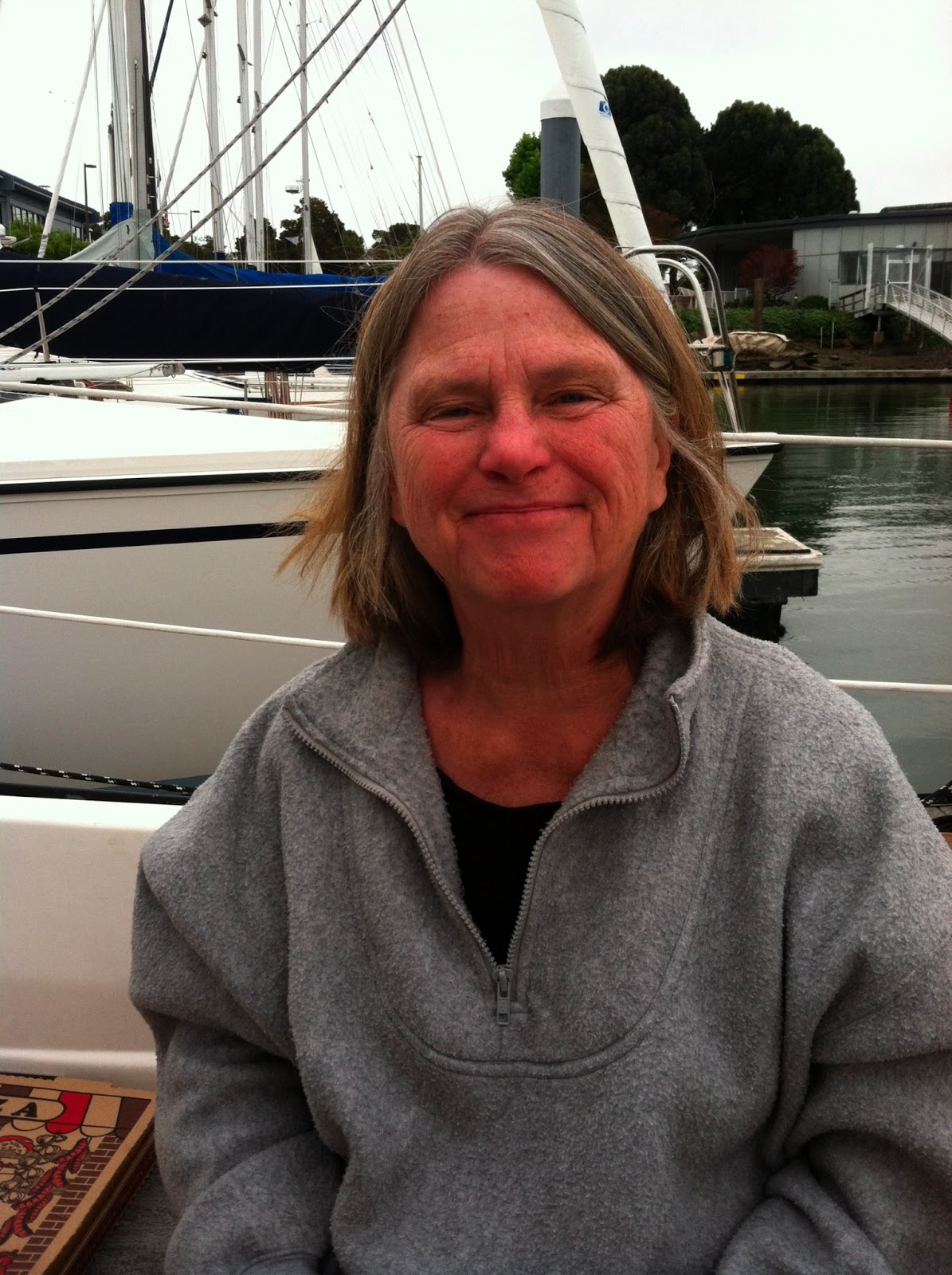
So the following is an announcement I put together for one in a series of concerts I am helping encourage at our little church. If you are nearby, come see us and hear some fine musicians next Saturday.
Life in the mountains, travel, retirement, music, journalism, family, politics, parks, sailing and a few brain drippings.
Sunday, July 28, 2013
More music is always a good thing
Murphys, Ca -- Most of my friends know I like many different kinds of music. If I play, I keep it simple (folk and bluegrass and gospel). But I love listening to almost everything (except obscene rap and acid rock).
So the following is an announcement I put together for one in a series of concerts I am helping encourage at our little church. If you are nearby, come see us and hear some fine musicians next Saturday.
Sunday, July 14, 2013
A little vacation by the Bay
| Me and my Modesto Bee souvenir shirt |
| Pat getting ready for a cool day of sanding and oiling teak |
Alameda, Ca -- Pat and I are staying aboard s/v Good News for a few days, mostly filled with the work any owner of a 32-year-old boat will know well (sand, clean, varnish, paint) but also a few happy breaks.
The weather deserves kudos after baking in the summer heat at home. Temperatures have ranged from the low 70s to the high 50s, with good fresh breezes every day.
We actually went sailing yesterday, Saturday, though we started late and stayed in the estuary. We did explore some new areas for us, moving south past Coast Guard Island to the bridge and back.
The photos are during a work break on board the boat. Pat says the shirt looks like I bled on it, but that is merely old deck stain. It IS my painting shirt.
| Looking across Marina Village en route to breakfast |
Today being Sunday, we declared it a NO WORK DAY and went to San Francisco for a full day. We started a bit late but with good intentions to attend Sunday worship at Noe Valley Presbyterian Church. Our friend Dianna Cheifetz is pastor and we wanted to hear her as she is a super preacher and person. We found the hospital parking garage (services were being held in the chapel) but discovered we were locked out of access and had to give up and drive out into downtown traffic and find something else to do.
We found the Buena Vista Cafe, overlooking the Aquatic Park and the cable car stop, and had bacon and eggs and good company (a young couple who communicated through sign language and their three-month old baby).
We bought Pat a cheap fleece (they are still a bargain) to hold off the cold wind and walked out onto the dock at the Maritime Museum to watch the preliminary race for the America's Cup. Our timing was perfect, though the "race" was not a race as only one boat was running the course due to an accident a few weeks ago which wrecked one boat and killed a crew member. The race was supposed to be an elimination heat, a warm-up for the real deal in September.
| America's Cup challenger running the course off Aquatic Park |
We met an interesting couple from Tampa Florida, that have traveled the world to see every America's Cup race in recent memory, only to get here and find that due to the accident and the extreme expense of putting teams together they won't see any real competition during their stay.
There are a lot of ticked off businesses and people in San Francisco because of the problems with the races. Simply put, even before the tragic accident a few weeks ago, about half the normal number of teams were competing. To compete used to cost sponsors about $150 million. This year's teams, because of the boat design chosen, are paying in the neighborhood of $500 million. Yep, that's a half BILLION dollars. Larry Ellison of Oracle is the host team, and while he can afford it, not everyone can or thinks it is worth that.
We had our brief look at the big time race, and then went back to spend a great hour at the San Francisco Maritime Visitor Center. It is a National Park Historical Site, and tells the fascinating story of how San Francisco developed along the bay.
| Rev. Jeff Cheifetz and son's self portrait |
| The gallery was crowded for his first San Francisco reception |
We walked down from Russian Hill to the parking lot ($33 for five hours) and drove along the waterfront in bumper-to-bumper traffic to come back across the Bay Bridge. We stopped off at the Oakland waterfront for dinner at Quinn's Lighthouse (yep, you can find it on the Internet). Crabcakes, fried chicken, salad and fries and a Sangria and a Guinness and the home to the boat.
All in all, a very full day. I may sleep in tomorrow.
Thursday, May 30, 2013
Parks for People? Or Just a Few People?
| At the Warming Hut last Winter |
| The Trail Through the North Grove |
If I wanted a wilderness experience I could explore the mostly undeveloped swamps, bayous and hills nearby. The sugar-white beaches of the Gulf of Mexico were close.
If I wanted to go camping I went with my Boy Scout troop, or slept out on an old Army blanket on the sand beaches.
Today private land is mostly closed off for fear of “unsuitable” people or lawsuits and beaches are wall-to-wall condominiums. If you tried throwing down a blanket to sleep you would probably be arrested as a vagrant.
Public parks -- both state and national -- have become much more important to me.
The Great Smoky Mountains provided my first park experience It was stunning to learn that unnamed people in earlier generations saved this special place for me.
I discovered state parks initially on Florida’s beaches and in her swamps. Fishing from the beach, watching a storm come in off the ocean or snorkeling on a coral reef were part of state parks.
When I migrated to California and was living near Yosemite National Park, it was a dream come true. My first trip there on an October day over 30 years ago, we woke up to snow covering our old VW camper. Wonderful.
My family discovered the wealth of state and National Forest parks and campgrounds across the state. There were almost no limits to where we could go and what we could see. Waking to the Pacific thundering onto a rocky beach, or a Roosevelt Elk’s bugling call, were made possible because of California’s parks.
All of this was affordable, from Yosemite to Prairie Creek on the North Coast, and could be reached within a day’s drive. A few more days put us into Washington, Nevada and Utah with enough parks to satisfy even me.
Today, the parks are still available where we can get in touch with our souls, or simply sit on a rock.
| The sequoias are the largest trees in the world |
I settled in Calaveras County because of my experience at parks along Highway 4’s corridor. Our initial criteria for our home was to be as close to Calaveras Big Trees State Park as possible.
A success story in recent years is the little park by the creek in downtown Murphys. It is available to everyone and used by many. “First Friday” concerts in the summer draw more people than live in the town. Kids play in the creek or on the playground equipment while families picnic. Office workers take their lunch breaks near the bubbling water. People dance, sing and play. The park is part of the glue that holds the community together. With no town government, local people support the park through fundraising efforts.
But there are no guarantees any of these parks will be available to our children and grandchildren. And potlucks and raffles won't keep state and national parks open.
A recent investigation by a watchdog group recommends the state system be revamped and modernized. Interestingly, they did not recommend the park system be privatized, and encouraged better taxpayer support for the system. They did recommend the forging of new partnerships with local communities and people.
National Parks have gone through lean years as well, which led to decisions to raise entry fees dramatically, and the rates for overnight stays in lodging have been climbing dramatically. When attendance immediately dropped, park officials wondered aloud what had happened.
Neither the California legislature nor the public has been very enthusiastic about parks in the last five years or so.
As a result, state and national parks may some day be reserved for the small group of people that can afford to pay prices too high for the average family. That is not what community should be.That was not the idea when the parks were set aside for everybody. I want my grandchildren to benefit the way I did.
People who love parks have to do a better job of explaining why parks have value for everyone. Parks really are places where knowledge is gained, health is restored, and we learn important stuff about our world and ourselves.
You know what parks do for you. Now is a good time to speak up.
![]() | ||||
| In the old days they knew how to be tourists! |
Note: This was originally written for the local paper, the Calaveras Enterprise, and was published last week. I added the pictures to give you an idea what my local state park looks like.
Thursday, March 21, 2013
In appreciation of newspapers - but not a memoir
Murphys, CA -- I hear that newspapers are dead or dying, and I know that change is the one sure thing in our lives. And few things have changed as much as newspapers in the past five to ten years.
But I still love newspapers. Not just the abstract idea of newspapers and their worth to society, but the look and feel and even the smell of ink on newsprint.
I can get just as irritated as the next person at the failures of newspapers, the greed of their owners, and the idea that we readers should pay more for less.
But I really love the newspapers that blessed my life with challenge, adventure, a life-time occupation, support for my family, and great, interesting and quirky friends.
Here's a personal history of newspapers where I worked, grew up, matured and eventually retired.
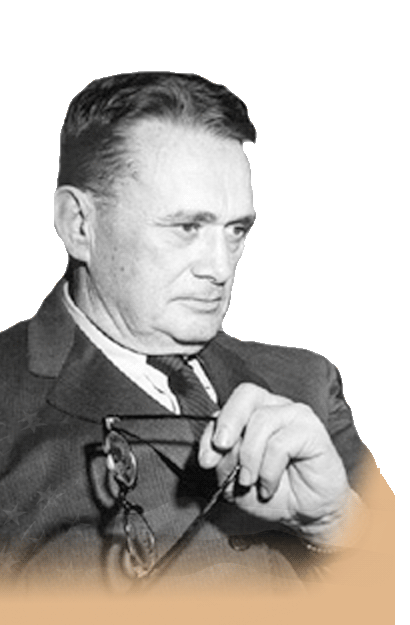
The Atlanta Journal was the biggest paper in Georgia when I started there as an intern in 1961, a summer of turmoil and excitement, and it schooled me in essentials I never forgot. My teachers were some of the best reporters and writers in the South, all keen on finding out what was really going on and letting the public know in crisp clear language.
I came back to the Journal as a reporter after graduation in 1962, and I still can't think of a better place to be a reporter (and a bachelor) than in a big changing city on a great afternoon newspaper. Where else can you cover a Klan Rally on Stone Mountain, Martin Luther King Senior preaching, a governor's campaign and expose crooked county officials and get paid for it.
The Army required me next, but even then I worked nights as a cop reporter for the Columbus Ledger-Enquirer. I made enough money moon-lighting to buy a Gibson guitar, and went back to being a full time soldier at Fort Benning.
When I ended my tour, The Miami Herald -- then the biggest and best paper in a booming state -- called me to come work in their bureau system. My long-dead grandfather had worked there as a printer.
I was lucky beyond belief to be assigned to the Herald bureau on the East Coast closest to Cape Canaveral where world-changing events were in the works, and lucky to have editors who left me alone (so long as I produced stories, which I did every day) and trusted me.
Then in 1966 I was lured away from the Herald by a guy named Al Neuharth, who convinced me his brand new newspaper (to be called TODAY) was some sort of holy quest and probably a charitable effort at the same time. Whatever was true, he offered me a chance to report full time on the then-booming manned space program, the time and travel to do it well, and a $10 raise.
I got engaged, accepted the new job and they gave me a week off to get married.
I was at the TODAY Newspaper (now re-named Florida TODAY) as Aerospace Writer, my very first title, and ended up writing about one of the biggest accomplishments in human history -- men on the moon -- for the Gannett chain of newspapers, a chain that grew into the biggest in the nation. I was even put on the corporate payroll, a nice way for the local editor to keep his costs down. And because I was in the right place, freelance writing offers came in almost daily from everywhere from the Washington Post Magazine to Paris Match.
As the manned space program wound down after Apollo ended, I was allowed to do more general science reporting, including ocean exploration, and that led me to the Virgin Islands, the Bahamas and elsewhere.
In early 1971 the company decided to open a Gannett News Service Bureau in the state capitol of Tallahassee, and I was tapped for that job. All of a sudden I was back to covering politics, but on a larger scale, traveling the state and the Southeast to cover news for seven newspapers. That led me to the political conventions of 1972 (McGovern and Nixon), and on the road with Southern governors named Wallace and Carter.
When you work for Gannett you never really unpack, so it was not a surprise that at the end of 1972 I was asked to go to the Fort Myers News-Press to work with my good friend Executive Editor Bob Bentley as his Managing Editor, and sooner than I expected as his replacement.
It does not do the paper and its people justice to skim over those years, but understand we were building and growing and doing our best work. In my early and mid 30s, I was leading a staff of bright and hard-working people. Those surviving, not on book tours and sober enough to travel show up for reunions almost 40 years later.
One of the verities of the newspaper business is that all editors serve at the pleasure of their publisher. I survived one publisher, but his replacement wanted an editor more cooperative with his business interest (and willing to ignore his greed).
I escaped to a sabbatical year at the University of Michigan as a National Endowment for the Humanities Journalism Fellow, and ended up after that as executive editor of the Marietta Times in Ohio. It was small town newspapering, more of a team playing together than workers. Everyone was underpaid and overworked and had a good time.
After 14 years with Gannett Newspapers, and moving six times, it was clear that a packed suitcase (and lots of publisher changes) would always be a requirement, no matter what your family situation. So when an unexpected call came from California to consider a different company, we put aside our West Coast biases and took a look.
I never really had heard much about the "Bee newspapers," much less considered working for a paper with an insect name. But when I checked out the man who made the call -- C.K. McClatchy -- his reputation was pure gold in West Coast journalism. He was president and editor of the company, but wanted an executive editor in Modesto. He offered professional integrity, no publishers in the system (I would report to him as CEO), and the first truly decent salary I had ever been offered.
It seemed too good to be true, but it was. I became the executive editor of The Modesto Bee, which turned out to be the longest tenured job ever for me, and a great opportunity.
During C.K.'s time the only problem I ever had was worrying why no one ever called from corporate to check up on Modesto's newsroom, or the content of the paper. I finally got up my courage to ask him and he told me he hired me to run the paper, not to be bugged by folks in the headquarters in Sacramento.
I was privileged to be in Modesto through boom and bust times, but mostly during times of growth and expansion. The staff size doubled over the years, and even through numerous changes (the company's expansion, public stock being offered, several changes in the general manger's post, and the untimely death of C.K. while out jogging) we were always able to do the kind of honest journalism he had established.
Change is the only constant in newspapers, and after 18 years as executive editor the company converted to a publisher top-down system, and the new publisher wanted a new editor.
I was offered a chance to go back to writing as Ombudsman for The Sacramento Bee. We left our long-time Modesto home, friends, church and neighborhood and moved into downtown Sacramento -- no commute required. I traded suits and ties and ten-hour days in six-day weeks for more relaxed garb, normal working hours for the first time in almost 40 years, and the job of being the readers' representative.
I wrote a column about the strengths and weaknesses of the newspaper, and rediscovered the joy of writing. I maintained the joy of talking with people -- both readers and staff -- about what makes good journalism.
In my new spare time we took up sailing, which has led to all sorts of good times and friends.
Finally, 43 years after walking into that first newspaper job, I decided to step aside, try new things, and give other people a chance to be as lucky as I had been.
It was an accident that I retired just before the industry began to collapse.
I was one of the lucky people in many ways.
How many people you know get to work their entire career with people they trust?
How many people get look back with affection at every place they worked, and recall it with fondness and a sense of satisfaction?
My friend and mentor John Quinn, a great American editor, was right when he said working for a newspaper is the most fun you can have with your clothes on.
My friend and mentor C.K. McClatchy, a great American newspaper owner and editor, was right when he said newspapers owe the public uncompromised honesty and independence from the influence of anyone who wants to hide the truth.
I still love newspapers.
Now newspapers are going digital. I always wanted to be cremated and have my ashes mixed into the giant inkwell of black ink that prints the words on the pages of your newspaper. That won't happen.
I still love newspapers.
But I still love newspapers. Not just the abstract idea of newspapers and their worth to society, but the look and feel and even the smell of ink on newsprint.
I can get just as irritated as the next person at the failures of newspapers, the greed of their owners, and the idea that we readers should pay more for less.
But I really love the newspapers that blessed my life with challenge, adventure, a life-time occupation, support for my family, and great, interesting and quirky friends.
Here's a personal history of newspapers where I worked, grew up, matured and eventually retired.
The Atlanta Journal was the biggest paper in Georgia when I started there as an intern in 1961, a summer of turmoil and excitement, and it schooled me in essentials I never forgot. My teachers were some of the best reporters and writers in the South, all keen on finding out what was really going on and letting the public know in crisp clear language.
![]() |
| Ralph McGill was the Journal-Constitution's voice for morality |
The Army required me next, but even then I worked nights as a cop reporter for the Columbus Ledger-Enquirer. I made enough money moon-lighting to buy a Gibson guitar, and went back to being a full time soldier at Fort Benning.
When I ended my tour, The Miami Herald -- then the biggest and best paper in a booming state -- called me to come work in their bureau system. My long-dead grandfather had worked there as a printer.
I was lucky beyond belief to be assigned to the Herald bureau on the East Coast closest to Cape Canaveral where world-changing events were in the works, and lucky to have editors who left me alone (so long as I produced stories, which I did every day) and trusted me.
![]() |
| The Herald's Bureau staff in 1966, with spouses |
I got engaged, accepted the new job and they gave me a week off to get married.
I was at the TODAY Newspaper (now re-named Florida TODAY) as Aerospace Writer, my very first title, and ended up writing about one of the biggest accomplishments in human history -- men on the moon -- for the Gannett chain of newspapers, a chain that grew into the biggest in the nation. I was even put on the corporate payroll, a nice way for the local editor to keep his costs down. And because I was in the right place, freelance writing offers came in almost daily from everywhere from the Washington Post Magazine to Paris Match.
As the manned space program wound down after Apollo ended, I was allowed to do more general science reporting, including ocean exploration, and that led me to the Virgin Islands, the Bahamas and elsewhere.
In early 1971 the company decided to open a Gannett News Service Bureau in the state capitol of Tallahassee, and I was tapped for that job. All of a sudden I was back to covering politics, but on a larger scale, traveling the state and the Southeast to cover news for seven newspapers. That led me to the political conventions of 1972 (McGovern and Nixon), and on the road with Southern governors named Wallace and Carter.
When you work for Gannett you never really unpack, so it was not a surprise that at the end of 1972 I was asked to go to the Fort Myers News-Press to work with my good friend Executive Editor Bob Bentley as his Managing Editor, and sooner than I expected as his replacement.
It does not do the paper and its people justice to skim over those years, but understand we were building and growing and doing our best work. In my early and mid 30s, I was leading a staff of bright and hard-working people. Those surviving, not on book tours and sober enough to travel show up for reunions almost 40 years later.
One of the verities of the newspaper business is that all editors serve at the pleasure of their publisher. I survived one publisher, but his replacement wanted an editor more cooperative with his business interest (and willing to ignore his greed).
I escaped to a sabbatical year at the University of Michigan as a National Endowment for the Humanities Journalism Fellow, and ended up after that as executive editor of the Marietta Times in Ohio. It was small town newspapering, more of a team playing together than workers. Everyone was underpaid and overworked and had a good time.
After 14 years with Gannett Newspapers, and moving six times, it was clear that a packed suitcase (and lots of publisher changes) would always be a requirement, no matter what your family situation. So when an unexpected call came from California to consider a different company, we put aside our West Coast biases and took a look.
I never really had heard much about the "Bee newspapers," much less considered working for a paper with an insect name. But when I checked out the man who made the call -- C.K. McClatchy -- his reputation was pure gold in West Coast journalism. He was president and editor of the company, but wanted an executive editor in Modesto. He offered professional integrity, no publishers in the system (I would report to him as CEO), and the first truly decent salary I had ever been offered.
It seemed too good to be true, but it was. I became the executive editor of The Modesto Bee, which turned out to be the longest tenured job ever for me, and a great opportunity.
During C.K.'s time the only problem I ever had was worrying why no one ever called from corporate to check up on Modesto's newsroom, or the content of the paper. I finally got up my courage to ask him and he told me he hired me to run the paper, not to be bugged by folks in the headquarters in Sacramento.
I was privileged to be in Modesto through boom and bust times, but mostly during times of growth and expansion. The staff size doubled over the years, and even through numerous changes (the company's expansion, public stock being offered, several changes in the general manger's post, and the untimely death of C.K. while out jogging) we were always able to do the kind of honest journalism he had established.
Change is the only constant in newspapers, and after 18 years as executive editor the company converted to a publisher top-down system, and the new publisher wanted a new editor.
I was offered a chance to go back to writing as Ombudsman for The Sacramento Bee. We left our long-time Modesto home, friends, church and neighborhood and moved into downtown Sacramento -- no commute required. I traded suits and ties and ten-hour days in six-day weeks for more relaxed garb, normal working hours for the first time in almost 40 years, and the job of being the readers' representative.
I wrote a column about the strengths and weaknesses of the newspaper, and rediscovered the joy of writing. I maintained the joy of talking with people -- both readers and staff -- about what makes good journalism.
In my new spare time we took up sailing, which has led to all sorts of good times and friends.
Finally, 43 years after walking into that first newspaper job, I decided to step aside, try new things, and give other people a chance to be as lucky as I had been.
It was an accident that I retired just before the industry began to collapse.
I was one of the lucky people in many ways.
How many people you know get to work their entire career with people they trust?
How many people get look back with affection at every place they worked, and recall it with fondness and a sense of satisfaction?
My friend and mentor John Quinn, a great American editor, was right when he said working for a newspaper is the most fun you can have with your clothes on.
My friend and mentor C.K. McClatchy, a great American newspaper owner and editor, was right when he said newspapers owe the public uncompromised honesty and independence from the influence of anyone who wants to hide the truth.
I still love newspapers.
Now newspapers are going digital. I always wanted to be cremated and have my ashes mixed into the giant inkwell of black ink that prints the words on the pages of your newspaper. That won't happen.
I still love newspapers.
Irish Music in Murphys
Murphys, Ca-- A Celtic band will present the first in a series of concerts by regional
musicians at the historic First
Congregational Church this Sunday afternoon.
"Cooking with Turf" will play beginning at 2 p.m. Sunday at the sanctuary at the corner of Church and Algiers streets, one block uphill from the Murphys Hotel. Refreshments will be served at intermission. A donation of $7 will be asked for at the door with the proceeds going to the musicians.
The series of concerts is sponsored by the church as a community outreach, and to provide the talented pool of local and regional musicians an opportunity to perform close to home. The band members in "Cooking With Turf" come from the Mother Lode and nearby valley towns, and play in venues from the Bay Area to the foothills. They specialize in traditional Irish and Scottish tunes.
The first congregation in Murphys was founded at the same site in 1853, and the old sanctuary building is pointed out as part of the weekly historic tours given by the local museum.
The schedule for later concerts is not yet established, but plans include music by groups that perform classics, jazz, vocal ensembles and individual performers. For inquiries about future performances contact the church office at 209-728-3141 or coordinator Sanders LaMont at 209-890-3172.
"Cooking with Turf" will play beginning at 2 p.m. Sunday at the sanctuary at the corner of Church and Algiers streets, one block uphill from the Murphys Hotel. Refreshments will be served at intermission. A donation of $7 will be asked for at the door with the proceeds going to the musicians.
The series of concerts is sponsored by the church as a community outreach, and to provide the talented pool of local and regional musicians an opportunity to perform close to home. The band members in "Cooking With Turf" come from the Mother Lode and nearby valley towns, and play in venues from the Bay Area to the foothills. They specialize in traditional Irish and Scottish tunes.
The first congregation in Murphys was founded at the same site in 1853, and the old sanctuary building is pointed out as part of the weekly historic tours given by the local museum.
The schedule for later concerts is not yet established, but plans include music by groups that perform classics, jazz, vocal ensembles and individual performers. For inquiries about future performances contact the church office at 209-728-3141 or coordinator Sanders LaMont at 209-890-3172.
Monday, December 24, 2012
One of those dreaded Christmas letters
Merry Christmas from our house to your house
**
I will eventually mail a few Christmas cards. but since it is Christmas Eve and I have not started, here's a report on our year.
It has been quite a year. I won’t try to cover it all in one letter. You’ll have to come visit us to get a fuller version of the story.
We started 2012 in our cabin in Camp Connell where we have been living for the past six years or so. While we were staying in a rental unit below the snow, our Realtor and friend called to say she had an unusual house for us to look at down the mountain in Murphys, Ca. It turned out to be two 80-year-old houses, on one piece of property, both needing work. So, of course, we bought them.
We moved into our new/old home at 340 Bret Harte Drive in late March as soon as we had three feet of water pumped out of the basement, and then started to work. The months since then have been near-endless chores, repairs, renovations and contractors.
Fortunately, the larger house was in reasonable shape, though stripped clean, and Pat and I started making the changes we wanted or needed. The biggest initial challenge was furnishing a large house after living in a small cabin. The first of many miracles happened when friends, both old and new, discovered they had furniture they no longer needed, or did not have room for. We can never repay the kindnesses we were granted, but we will surely spend years paying it forward.
The smaller house next door was a disaster, but after seven months of hard work and buckets of money our son Zack and Granddaughter Katie (and Rusty the dog) moved in, and are now our next door neighbors.
And our new/old home is very near daughter Ruth, her husband Brian, and fast-growing grandchildren Delaney and Connor.
Both houses still need some work, but thanks to many kind friends and workers we are in, and happy.
We are near our church, good friends, poker buddies and best bakery in California.
God has blessed us every one. Come see us.
Sanders & Pat
**
I will eventually mail a few Christmas cards. but since it is Christmas Eve and I have not started, here's a report on our year.
It has been quite a year. I won’t try to cover it all in one letter. You’ll have to come visit us to get a fuller version of the story.
We started 2012 in our cabin in Camp Connell where we have been living for the past six years or so. While we were staying in a rental unit below the snow, our Realtor and friend called to say she had an unusual house for us to look at down the mountain in Murphys, Ca. It turned out to be two 80-year-old houses, on one piece of property, both needing work. So, of course, we bought them.
We moved into our new/old home at 340 Bret Harte Drive in late March as soon as we had three feet of water pumped out of the basement, and then started to work. The months since then have been near-endless chores, repairs, renovations and contractors.
Fortunately, the larger house was in reasonable shape, though stripped clean, and Pat and I started making the changes we wanted or needed. The biggest initial challenge was furnishing a large house after living in a small cabin. The first of many miracles happened when friends, both old and new, discovered they had furniture they no longer needed, or did not have room for. We can never repay the kindnesses we were granted, but we will surely spend years paying it forward.
The smaller house next door was a disaster, but after seven months of hard work and buckets of money our son Zack and Granddaughter Katie (and Rusty the dog) moved in, and are now our next door neighbors.
And our new/old home is very near daughter Ruth, her husband Brian, and fast-growing grandchildren Delaney and Connor.
Both houses still need some work, but thanks to many kind friends and workers we are in, and happy.
We are near our church, good friends, poker buddies and best bakery in California.
God has blessed us every one. Come see us.
Sanders & Pat
Sunday, December 16, 2012
Progress Report
Murphys, Ca -- This blog is back from the dead -- or at least inactive -- for the past six months.
We've been a little busy.
At last report we had bought two 80-year-old houses in Murphys, in need of work and furnishings.
The living room was ripped up as the floors were being worked on. The bathroom had no working sink.
The plumbing was doubtful.
We had few lights, as everything had been stripped.
The smaller house was uninhabitable, and we had to consider demolishing it.
And we had almost no furniture.
Well, that has changed a lot, thanks to the incredible help, work and contributions from a village full of friends.
From the counter looking at the former breakfast nook, now a spot for dishes and local wines.
The Living Room, with restored hardwood floors, places to sit,
and stocking hung by the chimney with care.
The downstairs bathroom, now including a re-plumbed working sink, mirror, lights etc.
An office in work. That's a poster of my friend the late Bob Maynard on the wall.
And across our shared drivway, Zack happily working on his Subaru by his new/old home. New fences are in place for the dog, just lacking gates.
Our master bedroom is essentially done, except for pictures on the wall and the guest bedroom is sparse but useable. The spare bedroom has become Pat's exercise and music room.
Some other things have changed since the last report:
The heat works, and we have air conditioning.
The toilets flush, and they actually connect to the sewer.
The asbestos roof is replaced, and gutters installed.
The stucco is repaired, and the one-story house painted inside and out.
We have lights in ever room, and appliances cabinetry in the kitchen, and washer/dryer in the utility room.
The basements in both houses stay dry, most of the time, thanks to brand new sump pumps.
We have planted five trees and numerous bushes and ornamental plants, and hundreds of bulbs.
Credit for all the contributions of furnishings and labor will come later. We are considering setting up a plaque in bronze to honor the wonderful sharing we have experienced.
And we still are finding some surprises, like circuit breakers that pop regularly, slow drains, still-leaking basements, and places that flood when it rains hard.
But you get the idea.
We are home for Christmas.
We've been a little busy.
At last report we had bought two 80-year-old houses in Murphys, in need of work and furnishings.
The living room was ripped up as the floors were being worked on. The bathroom had no working sink.
The plumbing was doubtful.
We had few lights, as everything had been stripped.
The smaller house was uninhabitable, and we had to consider demolishing it.
And we had almost no furniture.
Well, that has changed a lot, thanks to the incredible help, work and contributions from a village full of friends.
The Family Room seen from the kitchen.
The Dining Room is in the background, table covered with Christmas stuff.
From the counter looking at the former breakfast nook, now a spot for dishes and local wines.
The Living Room, with restored hardwood floors, places to sit,
and stocking hung by the chimney with care.
The downstairs bathroom, now including a re-plumbed working sink, mirror, lights etc.
An office in work. That's a poster of my friend the late Bob Maynard on the wall.
And across our shared drivway, Zack happily working on his Subaru by his new/old home. New fences are in place for the dog, just lacking gates.
Our master bedroom is essentially done, except for pictures on the wall and the guest bedroom is sparse but useable. The spare bedroom has become Pat's exercise and music room.
Some other things have changed since the last report:
The heat works, and we have air conditioning.
The toilets flush, and they actually connect to the sewer.
The asbestos roof is replaced, and gutters installed.
The stucco is repaired, and the one-story house painted inside and out.
We have lights in ever room, and appliances cabinetry in the kitchen, and washer/dryer in the utility room.
The basements in both houses stay dry, most of the time, thanks to brand new sump pumps.
We have planted five trees and numerous bushes and ornamental plants, and hundreds of bulbs.
Credit for all the contributions of furnishings and labor will come later. We are considering setting up a plaque in bronze to honor the wonderful sharing we have experienced.
And we still are finding some surprises, like circuit breakers that pop regularly, slow drains, still-leaking basements, and places that flood when it rains hard.
But you get the idea.
We are home for Christmas.
Subscribe to:
Posts (Atom)