 |
| Working as a reporter, somewhere around 1970 |
===============
My nephew Ben asked to hear stories about the good old days when I was a newspaper reporter.
They were good. So here goes.
I was lucky enough to be present to witness and report on a lot of different stories from 1960 to the mid-1970s: Civil Rights activities in the South, hurricanes, politics, science and particularly the manned space program including the first landing on the moon. My journalism years included a era when newspapers were healthy, and growing and trusted -- the last decades of the 20th Century.
My interest in journalism began while a student at the University of Alabama during my last two years of college in the early 1960s. I was a transfer student, got into a journalism major by accident and discovered a whole new world I came to love.
For something to do I volunteered at the Crimson-White, the campus newspaper. This was in the era of big-time football and just before the University was forced to follow the law and integrate. Bear Bryant was the coach and Joe Namath was our quarterback. The school was all-white, dominated by fraternities I was not interested in. The paper was a hangout for independent folk, and I liked that.
The idea that as a "journalist" I could go almost anywhere, ask question of anyone, and then write about what saw and heard, captured me quickly: A license to be nosy, in a polite way of course, and win approval.
The big story in those years was the expose' by the paper of a campus political machine, based on the fraternity/sorority system, which ran everything on campus. Not much changed, but we felt we were on the side of truth and justice. But we also covered courts, cops, and everyday people.
We were not very sophisticated, and marginally effective, but we had a good time, even suggesting in an editorial that the school emphasised football too much. My writing was sincere, but amateurish.

My first real professional break came as I was winding up my junior year, by then working as managing editor of the campus paper. A senior friend Pat Potter suggested I apply for an internship at the Atlanta newspapers, at that time the biggest and best in the South. (Pat went on to become a very successful romance novelist, but that's another story.) It was a great opportunity. I grabbed it.
 |
| That's me, upper left in the trench coat, covering people the FBI said were Communists, and counter protestors, protesting Kennedy's Cuban blockade |
Working as a cub reporter that summer on the streets in Atlanta, then the acknowledged leader of the "new" South, was the most exciting thing I had ever done. It did not matter that I was immediately assigned the six weeks of writing obituaries (great training and discipline) or one of five interns. I learned basics that stayed with me: ask the right questions; assume nothing; organize your notes; keep asking and then write very fast for the early morning deadlines of an afternoon newspaper.
I made $45 a week, $5 more than minimum wage, and considered myself lucky. The low pay meant I had to be creative, boarding at the Sigma Chi fraternity house at Emory University even though I was a not a member or a student there. It was cheap and near the bus line.
Before the summer was over I got to cover police, fire, street protests, klan rallies, general assignment and even was sent out of town to follow a historical re-enactment through the hills of North Georgia on expense account! And the final week I was there was the week in which the Atlanta public school system integrated for the first time, and did so peacefully. Just being there to watch history being made forever cemented my commitment to newspaper work as the only job I would ever want.
My senior year in school flew by. I was commissioned in the Infantry on graduation in 1962, but had a one year gap before reporting for active duty.
The Atlanta Journal ("Covers Dixie Like the Dew") hired me back for that year as a staff reporter: at 21 years old and I had my dream job. I was assigned cover government and everything else north of the city, and spent most of year learning how to cover county and state officials. It was a year of change and turmoil in the South.
 |
| A train wreck was "good news" for a young reporter |
I even got one choice assignment to cover a little piece of the governor's race, in which a local restaurant owner and well-know racist named Lester Maddox ran for office the first time, unsuccessfully. I also covered sit-ins at local eating places, and the first-ever NAACP convention held in the South.
I also recall standing in the newsroom watching the Cuban missile crisis develop on TV, wondering if we would survive the next year. We did. And I was out on the street covering the protest marchers.
I had an apartment right on Peachtree Street, began to have a social life, and even bought a brand new car, a 62 VW bug.
Then the Army called and in May of 1963 I started two years of active duty at Fort Benning, Georgia, about 90 miles from Atlanta. I joined the Army to see the world, but never got out of Georgia. After training I was assigned to be editor of the base newspaper, not the most exciting journalism.
It was easy duty, with golf breaks at mid-week, so much so I volunteered to become the official Radio/TV Officer for the base. I did daily radio broadcasts, and a weekly television show. I even worked part-time at night for the Columbus Enquirer covering cop stories, until I made enough money ($130 after several months) to buy a decent guitar. Then I quit.
 |
| The haircut was for the Army. The skinny tie for the newspaper. |
Then a friendly colonel invited me to join an Infantry Company to see what the "real" Army was like. I did, and found that six-days-a-week and 18 hours a day were not that unusual when you are training troops and a platoon leader of an Infantry Company. Vietnam was just a word in the back pages of the New York Times but we worked hard.
And I learned a lot.
The "real" Army was something I did not want, and reminded me I really loved working for daily newspapers. So I mailed letters to the top journalism/news operations in the country. I did not hear back from Walter Cronkite at CBS or the New York Times, but The Miami Herald called, and the editor eventually hired me on the phone to come to Florida. (During my last week in

the Army, I also heard back from the Associated Press, but I turned down what looked like a job in the mid-west doing rewrites on hog futures on a night desk.)
The Herald had two rules in the newsroom operation at the time: the first, which I dodged, was that you could only be hired after Human Relations Department approved your scores on a battery of psychological tests. When I showed up, the HR people were unhappy but the editor was firm. I skipped the tests.
The second was that new reporters, even with experience like mine, were sent to the bureau system scattered over the state. I was assigned to the Cocoa Bureau, which I had to look up on a map. It was 50 miles east of Orlando, on the coast and next door to Cape Canaveral. The middle of nowhere in pre-Disney Florida. But is was near the beach.
I got an small apartment, traded my VW for a Triumph Spitfire sports car, and went to work as part of a team that was the northernmost outpost of the Herald, then the state's largest newspaper. I was expected to cover everything, take pictures of everything, and write multiple stories a day and get all to Miami by teletype (stories) or Greyhound bus (photos) by early evening.
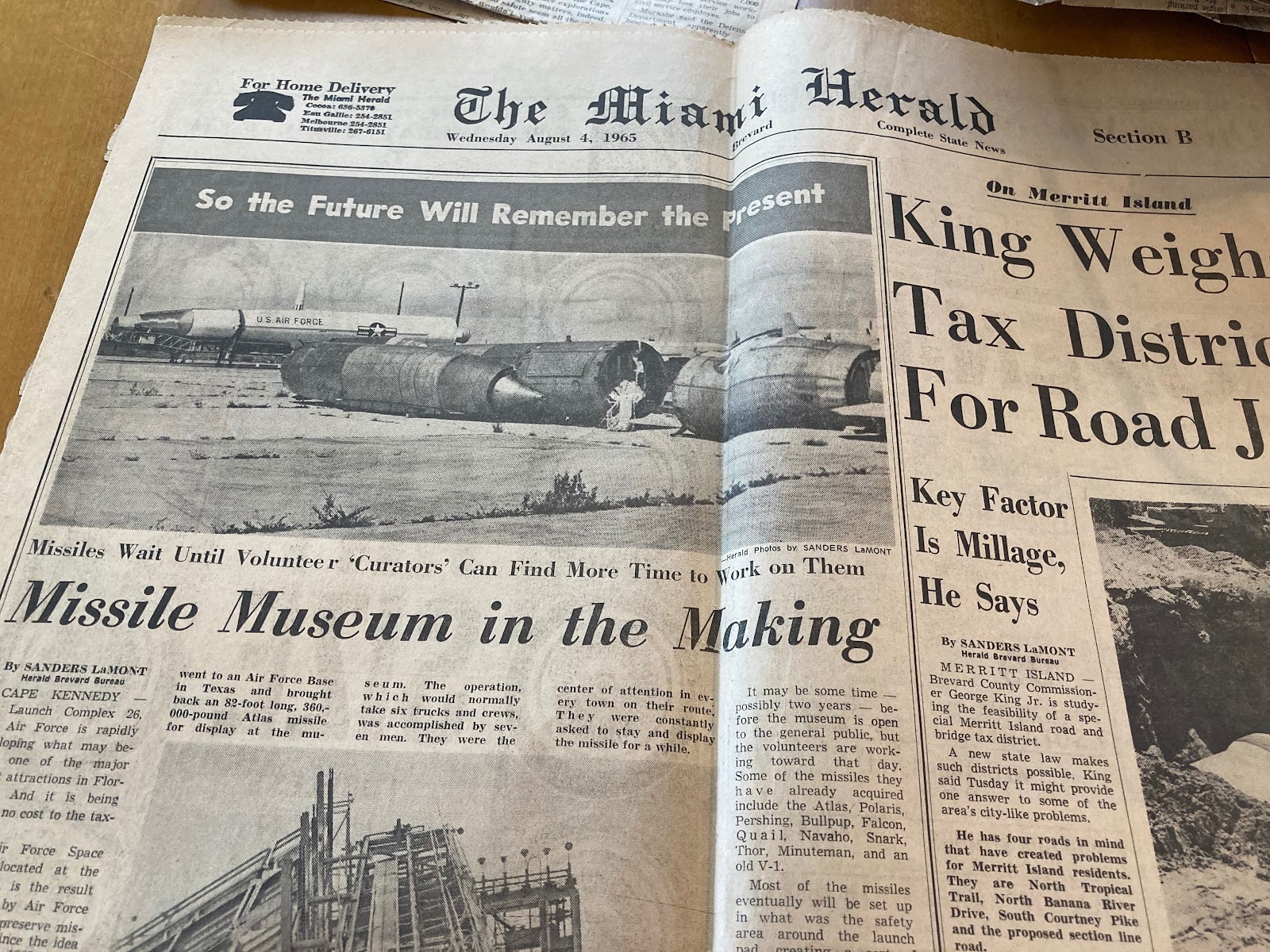

I even was required to take pictures of local, mostly teenaged, bathing beauties, for "filler" material. I was not good at it.
It was a great place to continue learning, including lessons not taught in journalism school. From one colleague I learned how to write features, with photos, quickly and with community interests. From another colleague, who had a serious drinking problem at the time, I learned how to move very fast to make sure the regional news page was filled, whether he showed up or not.
I accompanied an Air Force relief flight to post-hurricane Mississippi. But mostly, it was close to home stories. Cops. County government. Surfing contests.
Within a month I discovered I was also expected to report on major events at the then-building space center at Cape Canaveral. The idea of being paid to go watch missiles and rockets launch into space, and write about it, was like dying and going to heaven. My first big assignment was to cover the launch and flight of Gemini 4, in June 1966, the mission during which astronaut Ed White made America's first space walk.
A beautiful young woman was working at the reception desk at the press center. I later married her.
 |
| A typical Herald assignment. |
Over the next year between military launches and manned space launches by NASA, I was at Cape Canaveral several days a week reporting. I found that by being at the Cape I had an advantage over the other press that only flew in for a few days, and began to try and convince the editors in Miami that should be my full-time assignment. They were not interested.
 |
| Passes for the Gemini Program |
I loved working for the Herald, a great newspaper, but was frustrated at the short-sightedness. Apollo was coming, and they did not understand how important that was. I was running back and forth between the build-up of the Kennedy Space Center, where millions of tax dollars were spent on a national goal of a moon landing, and making sure I checked the police reports at Rockledge City Hall.
Things were changing in other ways. First, I had met my wife Pat, who worked for NASA, and we were engaged. Second, the Army tried to call me back to active duty which I politely declined. Third, a newspaper company called Gannett bought the three biggest weeklies in the county adjacent to Cape Canaveral and announced they were going to start a brand new daily newspaper to cover the area around the Cape.
I was invited to interview for a job, and was offered a job by the corporation president, a guy named Al Neuharth, but he told me the space program was already assigned. It was the only assignment I was interested in. I turned him down and went back to the Herald's routine.
The first week of the new publication, the TODAY newspaper, the new editor Jim Head called and offered me the job of Aerospace Writer for the paper and the parent company's Gannett News Service, at a considerably better salary than the Herald. I accepted and gave two weeks notice, with the agreement I could have a week off to get married in August
and two weeks in June for the Army.
 |
| Pat talking with Editor Jim Head, one of the great Florida editors at TODAY |
Almost exactly one year after joining the Herald I joined the staff of Today/Gannett.
The new assignment was a dramatic change. I was in charge of my time, the stories I chose to do, and how I went about it. As a first step I began spending a lot more time at the space center, or the adjacent Air Force station, meeting more people, building contacts and covering more minor stories -- way to build contacts for the future. In the mid-60s NASA was building up, and the Defense Department was also developing missile programs of their own. There were launches from the Cape at a rate of one or more per week.
 |
| Running to the TODAY office after a day at The Cape |
The city editor, my nominal boss, suggested I should just report to the news editor who dealt with page one because that's where most of my stories were going. I just told that editor what I was doing, and he said go do it. A reporter's dream.
The Army got two more weeks of my time that summer, assigning me to the North Carolina National Guard as air liaison officer, a rather odd assignment, but I was finally done with the Army.
Gannett was pouring money into TODAY to make it a success. All of a sudden I had the ability to travel, including other major space centers around the country and aerospace contractors on the West Coast. They gave me the opportunity not only to cover the events, but to get to know many of the people -- astronauts, flight controllers and others who made the moon landing possible.
 |
The Gemini Program ended in Fall 1966, and all the effort was looking ahead to Apollo's goal of landing on the moon by 1970.
In between launches I covered other stories, like a hurricane on the Gulf Coast near where I grew up.
 |
| Along the levees in Louisiana after the hurricane |
 |
| Somewhere near Biloxi after the storm |
Then tragedy struck at the Cape in January 1967. The phone rang and a friend who worked for NASA said "You better get to our office right now."
The big story was the launch pad fire that killed three astronauts, and put the entire program in limbo. NASA's reaction and investigation took up much of the next six months. These were people we knew, and it was emotionally wrenching. Some nights I would finish writing a story, and then weep in my car before driving home.
I spent the summer of 1967 reporting from the Washington Bureau, an assignment designed to help build contacts with senior NASA officials. (When I complained about being away from my new wife, the company sent her to join me for the summer. We lived in the then-dilapidated Willard Hotel.)
Most of the reporting that year was on the aftermath of the fatal fire, and the changes that had to me made. Every detail seemed newsworthy, and more and more of the public was paying attention.
 |
| At the NORAD facility in Colorado; That's Milt Sosin on left, a famous reporter from the Miami News, me in the middle, and George Alexander later of the L.A. Times on the right. |
Another focus from the Washington assignment, was a series on the impact of space technology across the nation. (I reworked it into a free-lance story for the Washington Post later. That brought in extra income, and my TODAY bosses approved.)
By this time we were building relations with the other Gannett newspapers around the country, meaning that the stories I wrote were on the national wire service and began showing up in papers in New York. Illinois and elsewhere.
In addition to manned flights, I also covered the development of military missiles, including the submarine launched Poseidon. We watched from a Navy vessel offshore as the submarine launched, but it turned out the Russians were interested too and stationed what they called a "trawler" near us to watch and collect data. We had a close encounter of the Cold War kind when the trawler ignored warnings and came within 100 yards of us. Nothing bad happened, but it made an interesting day.
 |
| Once we understood they were not going to ram us, the close encounter with the Soviets was amusing. |
The Apollo program got back on track and by December of 1968 Apollo 8 had circled the moon, and given the nation confidence the goal might be reached. Our Christmas tree was never fully decorated that year because I had to back to work.
 |
| Earth as seen by the Apollo 8 crew; a photo that changed things |
That was the last mission I covered just from Florida, as Mission Control had moved to Texas. That began a routine of trips to Houston with every flight, working very long days, and living in a motel for two weeks or so at a time.
By May of 1969 Apollo 10 was orbiting the moon in a dress rehearsal for the first landing.
By this time the launches were attracting world wide attention, and large crowds. The demand for information was such that I was getting calls from news agencies wanting to buy stories on a freelance basis. In the course of six months or so before the Apollo 11 launch to the moon landing, I had stories appear in the French Press Agency, Paris Match Magazine, the Washington Post, an encyclopedia and several smaller magazines. I was also doing radio shows from the launch pad, providing "expertise" to the Gannett owned local station.
Our lives at home were built around launch dates, space missions. And a pregnant Pat. She quit her job at NASA and stayed at home.
 |
| In the press bleachers for Apollo 11 |
Apollo 11 was unlike any story anyone could remember. There were more than 4,000 accredited press people present for the launch. The permanent press corps at the Cape, of which I was a part, probably had no more than 20 people assigned.
By July 1969 I was spending about 80 hours a week at work, and writing three or more stories a day, all about Apollo. The entire staff of TODAY was involved, and beefed up with editors and writers on loan from Washington and New York. Endless planning sessions, trying to cover every possible angle and possibility, ate up our time.
NASA hosted a dinner one night prior to the launch which I was invited to attend. Present were the usual NASA bigwigs like von Braun and a few astronauts, but Walter Cronkite was across the table and a writer named John Dos Passos was in the seat to my left. The room was crammed with people I had only heard of. I was a 28 year old newspaper reporter. And I worked for the largest newspaper chain in the country. Life was good. I listened, and kept quiet.
 |
| Doing radio "color" at the Cape. |
When the launch finally took place, I had been at my desk at the Kennedy Space Center launch site since before dawn. The press area was a giant bleacher, with built in desks, phones and whatever else we needed. The television networks had their own portable studios in trailers on site. The enormous press contingent overflowed onto the grass and all around the official site.
 |
| Apollo 11 |
When the launch finally came the morning of July 16, it was both powerful and awe-inspiring. More than one jaded journalist said a quiet prayer because we knew how very dangerous it was for the crew. The light fixtures in the roof of the stands rattled and swayed and the low pressure waves beat against our chests. Uncharacteristically, many of the "press corp" cheered. Pat, pregnant and retired from NASA, watched from the causeway and munched on soda crackers.
At the press site I took notes on my portable Underwood typewriter, and provided some radio comments for broadcast colleagues.
I had already written what we called "'A' matter" for the wire service story, so I dictated a lead for the Gannett News Service that said men had headed for the moon.
Several of us waited until the crew was safely in orbit before heading to a post-launch press conference, and then back to the office on the mainland to write more detailed stories about the day. At my desk in the TODAY office I had wired a communications box so I could hear all the NASA commentary and as much of the astronaut conversations as they would let through.
Because of multiple deadlines I wrote several versions of the launch-day story that afternoon and night, before heading home to pack a bag for a flight to Mission Control in Houston the next morning. I was at my other work desk, at the Mission Control Center in Houston, by afternoon writing the next in a stream of stories from that week.
I worked from my Houston desk, usually wearing headphones to listen to the astronauts. Nearby were friends from Newhouse Newspapers and the French Press Agency. We would back each other up if someone was away for a few moments.
 |
| Buzz Aldrin on the moon |
I had a copy of the official Flight Plan on my desk so I could see what the astronauts were supposed to be doing every moment. I would write an early version of stories for afternoon newspapers, handing copies to a Western Union runner who would take them to the nearby office inside the building and send the stories by teletype to New York, the base for Gannett.
After the landing took place safely, my friend from the French Press Agency pulled out a bottle of wine, and toasted America. "You Americans," he said, "do not understand how important this is."
Stories were constructed in parts, with background or filler material going out first, and then new "leads" as events progressed through the day. I kept a set of carbon copies on my desk to keep track of everything. For the next eight days I wrote about three stories a day, and then I stayed until the astronauts came back to Houston for quarantine in their specially
constructed Airstream quarantine trailer.
 |
| Safely onboard the aircraft carrier |
The Apollo 11 mission required all the expertise the nation could provide, and very long days and nights for everyone involved. There was a sense of accomplishment, and exhaustion. And the public immediately lost interest.
 |
| Benefit of being a reporter: you get a ride in a moon car |
For most of the next year I spent my time going back and forth from Cape Kennedy to Houston, covering the subsequent Apollo flights. The scariest was Apollo 13, when no one was really sure the astronauts would survive. The most forgettable was Apollo 17, the last mission in 1972. By then the public had lost interest and stories were mostly back page or inside.
During the time after Apollo 11 I expanded my reporting role to include more science writing, specifically the then-developing world of oceanography. I took a scuba course and talked my editor and friend Bob Bentley into letting me travel and do interesting stories. In between Apollo launches.
 |
| Diving to write stories in the Florida Keys and Bahamas was just part of the science writing job. |
That led to trips to the Virgin Islands to write about an underwater habitat, the Bahamas for a story on mini-submarines, and the Florida Keys for stories on the environment and other fun stuff.
 |
| In the Virgin Islands to dive on an underwater habitat. |
I left the space coast, and the full-time assignment of covering the space program, and science, when Bentley asked me to move to Tallahassee, Florida, as the chief of bureau for Gannett News Service. We were to cover state government, with emphasis on items of high interest to the Florida newspapers (seven at that time). My new boss was John Quinn, then head of GNS, and one of the best newsmen in America. In a famous encounter, in answer to a question from John, then President Richard Nixon announced "I am not a crook." Events proved he was.
I continued to write news stories on a daily basis, usually about the workings of state government and what the elected representatives were up to. It was a fun assignment, with competition always present and some Florida scoundrel in public office usually available to make a good story.
I was lucky enough to cover three major events in that time period: the 1972 presidential nominating conventions in Miami; the return of the Prisons of War from Vietnam, and Southern politics, including the early skirmishes between Jimmy Carter and George Wallace.
 |
| The stuff of covering the legislature. |
And it was in Tallahassee that I met a political leader who proved to be honest, and principled, in all the years he served. Reuben Askew, whose campaign for governor I covered around the state, still stands as a public servant who deserved the admiration he gained, and who should have been taken more seriously.
 |
| I did a lampoon of the press secretary "polishing" his image, but the governor won the night by singing "An Okie from Muscogee." |
I will always be grateful that I happened to be in the right place at the right time as a journalist. I met some great people, like Martin Luther King Senior, or "Daddy King" as he was known, and people working inside the space program whose names never made the news.
I met and covered some small-minded jerks, like George Wallace and the Klan leaders on Stone Mountain in Georgia and a few of the Panhandle legislators who made money off public office.
 |
| That's President Ford on the right, and me peeking out in the center, at the White House |
I met some Presidents, great or maybe not, like Johnson, Ford and Carter, all people who sacrificed for the public.
I met some arrogant, but smart, people like Wernher von Braun and Al Neuharth.
And I met many brave and dedicated people like the astronauts that risked their lives for the sake of exploration and adventure and science and their country, and the people that supported them.
My career as a reporter pretty much ended in 1973, about a decade after it began, and Al Neuharth gets the credit or blame. After I had been bureau chief for a couple of years, I attended a gathering of news executives in Pensacola. It was a routine gathering editors and publishers and corporate executives, with too much to eat and drink, and little real work.
As I was heading for the airport to leave, I ran into Al in the lobby that morning. We chatted about nothing special, and then he casually asked me if I ever considered being the editor of a newspaper. Our mutual friend Bob Bentley was in the process of remaking the Fort Myers News-Press, and could use some help. I was not overly charmed with the idea, and quickly forgot the conversation. A few days later Bob Bentley called and asked me to come be his assistant in Fort Myers, with a vague job description and more money.
Once I made that move, I was an editor, a title I held for the next 25 years in three states.
It took a while to adjust to the idea of working with other writers, and photographers, and page designers. But I liked it. I particularly enjoyed the fact that in my editor years, which covered the next 3 decades or so, I was able to look for and recruit great journalists, often in the first years of their careers, people who would later go on to do truly great work. I knew great writers. Great page designers and photographers. Great editors. The talent within the big room of journalism at newspapers, comes in many forms. What they have in common is curiosity, honesty and talent.
I love the fact that so many people I hired when they were young are doing well, some as novelists, some as magazine writers and some as newspaper editors. Many moved into other fields with great success.
I love the idea that while I started at two of the largest papers in the country, it was at mid-sized papers that I had a chance to help develop such great young talents.
And I love the fact that when, after more than a dozen years working for a fast-growing corporation Gannett that I got a chance to be an editor for a family run company -- McClatchy -- led by people of principle and integrity.
Nothing lasts forever, or course, and things are always changing. Journalism is always changing.
But nothing beat the fun of being a reporter, out there on the streets, gathering the news and putting it down on paper, and seeing it on the front page the next morning. I am jealous of those who still do that. The tools may be different -- iPhones and computers instead of a notebook and pencil and access to a pay phone -- but it remains one of the great professions in the world.


