Camp Connell, CA -- Spring is trying to arrive here, but it is a challenge.
In the past week we have seen sunshine, breezes, rain, sleet, snow, and finally more sunshine late today.
The video is a first attempt, so forgive the rough cuts. But it is less than two minutes long and gives you a picture of what this week has been like.
Friday, April 10, 2009


Wednesday, April 8, 2009
Never before Frog Jump

Camp Connell, CA -- A local expression, transformed into holy writ for gardeners, goes like this:
"Never plant before Frog Jump."
You have to be a resident of Calaveras County, California, in the gold country, or a devoted fan of Mark Twain's colorful prose, to make the link between then - the 1800s -- and now.
Remember the story, "The Celebrated Jumping Frog of Calaveras County," by Twain?
In the current century local boosters of tourism have adopted, or hijacked, the frog story to create a local festival/fair called the Jumping Frog Jubilee, centered at the Calaveras Fair Grounds and the city of Angels Camp. To locals, it is just called "Frog Jump."
It is a REALLY big deal. We even have a Frog Jump Princess, a significant local honor. And we have champion frogs, and brass plates cemented into the sidewalks of the town to commemorate great jumps and jumpers of the past.
But the highlight is the annual frog jump contests. That's plural "Contests" because the folks at the county fair jubilee and the local club that "owned" the frog jump contest had a tiff that resulted in competing jumps.
But people still come for both, enter frogs domestic and foreign, and vie for the jumpiest. Check it out at http://www.frogtown.org/
The big event(s) is(are) planned for the week of May 14, which for most people around the country would be late Spring.
Not for us.
Frog Jump, as we call it here in the mountains, is the date before which you plant your garden at great risk of a late season freeze.
I confess I have not taken this too seriously, so as Spring-like temperatures flowed up the mountainside in the past two weeks I have been dreaming of flowers.
Yesterday, Pat worked in the raised garden beds at our daughter's home, getting ready for planting. The chickens helped by scratching around for bugs in the warm sun.
I took the snow tire chains out of the van and put them away at our house. And just last week, as the ground became almost totally free of snow, I put the snow blower away for the season.
We are currently in Murphys, lower down the mountain, horse-sitting for our daughter and family. It turned cold and rained here at 2,000 feet last night, and then the phone rang early.
A neighbor called to change the weekly poker game location because we have too much snow at home, closer to 5,000 feet. About six inches on the ground and still coming down when he called. About a foot when I checked later on a webcam located near my home.

At least we didn't plant before Frog Jump.
Maybe I should apply the lessons of the local culture to things like snow blowers and tire chains.
I still have to figure out how to get home without chains. Maybe I can borrow the horse.
Thursday, March 19, 2009
Newspapers failing: Was it something I did?
Camp Connell, CA -- I fail to see how anyone other than a convicted Luddite can take joy from the failure of newspapers across America.
I certainly don't.
And it appears that more newspapers will certainly close their doors in the next few months.
Democracy (with a small "d") will suffer if more follow the Seattle Post-Intelligencer down the tubes. The voices you hear cheering on the sidelines are generally uninformed about how a democracy works, unkind, or just plain stupid.
I don't think the decline is my fault even though I spent more than four decades working for seven different newspapers and one wire service in four states. Some people think I retired just in time, but they don't understand how much of my life savings was (past tense) invested in newspaper companies.
I know about news available on the Internet. That's how I get most of my news these days, and it is unsatisfactory. Most Internet news sites are variations on the Entertainment Network: 15 seconds of flash about something interesting -- for one moment -- and of no particular significance. Octomom comes to mind.
Even the better web sites established by good newspapers tend to be less than the whole, a mere glimpse into the information that should be there. Very few news web sites offer anything close to what even a small daily normally offered to its readers.
Daily newspapers are struggling to maintain a positive outlook, but it gets harder every day in face of the economy and a public that's not terribly interested.
Everyone associated with the news industry is trying to figure out who to blame, and what to do next.
The Internet has changed society, but it should not be blamed for the decline of newspapers.
Here's my personal list of causes, effects and blame:
-- Greed. Bigger and bigger retail businesses controlled more and more advertising dollars and insisted on more and more control of news content. They went bankrupt when the economy dumped leaving newspaper companies holding an empty bag. I know all about the influence of the Internet, but the reality is that most American newspapers took a major financial bath from the series of bankruptcies that have dotted the retail landscape this past year. Retail advertising was at least 80% of a daily newspaper's income stream. Craigslist dented another 10 per cent.
-- Bad judgment. Newspapers rushed to jump into the Internet news business, which was a good idea, but decided to give away the content they owned, which was the worst idea since the electorate chose George W. Bush. We made our choices, and now we live with the results. No wonder young urbanites who are willing to pay $4 for a latte on the way to work turn up their noses when newspapers went up to a quarter.
-- More greed. Newspaper corporations changed from fiscally conservative to high-flying borrowers and decided that they had to grow bigger and bigger to survive. Banks were happy to loan big bucks (sound familiar?) because everybody knew the economy would boom forever. A critical mistake was made by a lot of normally level-headed people. If it were not for the mountain of debt burying most large news companies, the industry would be making adjustments and waiting for better days. Most daily newspapers still make more money than they spend, which is called "a profit," but can't pay off massive debts they would never have considered taking on a decade ago.
-- More bad judgment. America's culture changed and newspaper executives did not notice, or did not know how to react. The public became more and more fragmented and less and less willing to support the American idea of diversity of voices the Constitution protects. Blame this on a declining education system, or whatever, but the reality is most Americans today are pretty intolerant of opinions they don't agree with, conservative or liberal, and gravitate toward louder more pointed voices they agree with and are not forced to think about. Rush and Rachel are entertaining, but not always helpful. Yes, I am saying we are dumber than we used to be. The Internet is ideal these days because you can always find someone, no matter how nuts, who agrees with your deeply held but really stupid opinions. (Don't take it personally. I count myself among those who read the Internet this way.)
-- And still more greed. For the past 25 years American newspapers, like politics, became more and more "business friendly." Car dealers complained that reviews of automobiles were "anti-business," and threatened to withhold advertising. Real Estate and development interests claimed the newsroom was "anti-growth" and "unfriendly," and publishers all over the country came up with a brilliant idea. Presto Chango, publishers moved Auto and Real Estate Sections to the advertising departments where nary a critical word was ever printed. Readers knew they were being had and quit reading what that saw as pablum and became more suspicious of the rest of the paper. Meanwhile union leaders made unreasonable demands and preached an anti-business litany that backfired, that triggered mindless union-busting by management, and everyone was hurt except the lawyers who were paid by the hour.
There are numerous other contributing factors, but this list is long enough to think about for a while.
Then, maybe, we can come up with some solutions.
------------
Looking back at the headline at the top of this blog I am forced to answer the question: Yes, I am partly to blame but it was mostly things I did not do, rather than what I did.
I did not yell loud enough, resist loud enough, nag enough and refuse to compromise enough. It might not have changed things, but if enough American editors had taken hold of the high ground instead of enjoying their perquisites and worrying about their bonuses, we might all be better off.
I was pretty irritating as an editor, but not nearly irritating enough. Mea culpa.
I certainly don't.
And it appears that more newspapers will certainly close their doors in the next few months.
Democracy (with a small "d") will suffer if more follow the Seattle Post-Intelligencer down the tubes. The voices you hear cheering on the sidelines are generally uninformed about how a democracy works, unkind, or just plain stupid.
I don't think the decline is my fault even though I spent more than four decades working for seven different newspapers and one wire service in four states. Some people think I retired just in time, but they don't understand how much of my life savings was (past tense) invested in newspaper companies.
I know about news available on the Internet. That's how I get most of my news these days, and it is unsatisfactory. Most Internet news sites are variations on the Entertainment Network: 15 seconds of flash about something interesting -- for one moment -- and of no particular significance. Octomom comes to mind.
Even the better web sites established by good newspapers tend to be less than the whole, a mere glimpse into the information that should be there. Very few news web sites offer anything close to what even a small daily normally offered to its readers.
Daily newspapers are struggling to maintain a positive outlook, but it gets harder every day in face of the economy and a public that's not terribly interested.
Everyone associated with the news industry is trying to figure out who to blame, and what to do next.
The Internet has changed society, but it should not be blamed for the decline of newspapers.
Here's my personal list of causes, effects and blame:
-- Greed. Bigger and bigger retail businesses controlled more and more advertising dollars and insisted on more and more control of news content. They went bankrupt when the economy dumped leaving newspaper companies holding an empty bag. I know all about the influence of the Internet, but the reality is that most American newspapers took a major financial bath from the series of bankruptcies that have dotted the retail landscape this past year. Retail advertising was at least 80% of a daily newspaper's income stream. Craigslist dented another 10 per cent.
-- Bad judgment. Newspapers rushed to jump into the Internet news business, which was a good idea, but decided to give away the content they owned, which was the worst idea since the electorate chose George W. Bush. We made our choices, and now we live with the results. No wonder young urbanites who are willing to pay $4 for a latte on the way to work turn up their noses when newspapers went up to a quarter.
-- More greed. Newspaper corporations changed from fiscally conservative to high-flying borrowers and decided that they had to grow bigger and bigger to survive. Banks were happy to loan big bucks (sound familiar?) because everybody knew the economy would boom forever. A critical mistake was made by a lot of normally level-headed people. If it were not for the mountain of debt burying most large news companies, the industry would be making adjustments and waiting for better days. Most daily newspapers still make more money than they spend, which is called "a profit," but can't pay off massive debts they would never have considered taking on a decade ago.
-- More bad judgment. America's culture changed and newspaper executives did not notice, or did not know how to react. The public became more and more fragmented and less and less willing to support the American idea of diversity of voices the Constitution protects. Blame this on a declining education system, or whatever, but the reality is most Americans today are pretty intolerant of opinions they don't agree with, conservative or liberal, and gravitate toward louder more pointed voices they agree with and are not forced to think about. Rush and Rachel are entertaining, but not always helpful. Yes, I am saying we are dumber than we used to be. The Internet is ideal these days because you can always find someone, no matter how nuts, who agrees with your deeply held but really stupid opinions. (Don't take it personally. I count myself among those who read the Internet this way.)
-- And still more greed. For the past 25 years American newspapers, like politics, became more and more "business friendly." Car dealers complained that reviews of automobiles were "anti-business," and threatened to withhold advertising. Real Estate and development interests claimed the newsroom was "anti-growth" and "unfriendly," and publishers all over the country came up with a brilliant idea. Presto Chango, publishers moved Auto and Real Estate Sections to the advertising departments where nary a critical word was ever printed. Readers knew they were being had and quit reading what that saw as pablum and became more suspicious of the rest of the paper. Meanwhile union leaders made unreasonable demands and preached an anti-business litany that backfired, that triggered mindless union-busting by management, and everyone was hurt except the lawyers who were paid by the hour.
There are numerous other contributing factors, but this list is long enough to think about for a while.
Then, maybe, we can come up with some solutions.
------------
Looking back at the headline at the top of this blog I am forced to answer the question: Yes, I am partly to blame but it was mostly things I did not do, rather than what I did.
I did not yell loud enough, resist loud enough, nag enough and refuse to compromise enough. It might not have changed things, but if enough American editors had taken hold of the high ground instead of enjoying their perquisites and worrying about their bonuses, we might all be better off.
I was pretty irritating as an editor, but not nearly irritating enough. Mea culpa.
Tuesday, February 17, 2009
And now, for a look at the weather

Camp Connell, Ca. -- We needed some snow.
Well, we got it. The photo shows the scene out our living room window at noon today, with the "more snow" weather forecast on TV. They say it may quit tonight for two days, then start again.
In the last eight days or so we have five to six feet of new snow.
It is enough to satisfy me, actually, but the TV folks say we are still behind the snowpack needed to avoid another drought year this summer and fall.
Don't get me wrong, we really like snow to admire and play in. But there are certain issues: Pat had to spend the night down the mountain to make a scheduled 7:30 a.m. meeting at our granddaughter's school; the meeting was canceled because of snowy roads; we missed church Sunday, and two board meetings were canceled due to icy roads; I can't go skiing either because the roads are too bad, or I am too timid to ski in deep powder, or as we call it here, Sierra Cement.
I could not get out the dirt road to the highway this morning even in my truck because of 18 inches of new, very wet, snow.
It was so wet Mr.Miller, the plow fellow, had to use a giant front-end loader to clear the road enough for his snow blowers to get to our driveway.
The top photo shows him clearing the road at the top of my driveway, and the bottom photo shows the blower clearing the drive by our doorway. My semi-buried truck is barely visible.


They did get it cleared enough for us to get in and out.
For now I am using this blogging break as an excuse not to go outside and shovel the garage entrance clear of the snow now piled up against it.
No problem.
Tonight, I will just throw a burger on the barbie and kick back and, probably, watch the snow. That's the barbie in the picture. It took about an hour to get the deck cleaned off, less than normal thanks to son Zack repairing the deck blower.

I think I'll have some fun and stay in and work on my taxes.
Tuesday, February 10, 2009
Living in a post card
Our local web site posted a short video today of the road conditions in our neighborhood, after about a foot of new snow.
The webmaster referred to the scenery here as "living in a post card."
You can see what he means by following the link and clicking on the YouTube video.
The entire video is over seven minutes, maybe too much for most of you. If it is, advance to the last minute. Those who know this part of the country, or who have visited our home, will recognize the last minute of the video as showing the ride from Dorrington, home of the Lube Room saloon/ bar and grill, a quarter mile to the Camp Connell General Store (and our post office), and the turnoff to our side road.
www.bigtreestech.com/home/
Or the direct YouTube link
http://www.youtube.com/watch?v=XnugUK2JZNo
If you check the links too late, you'll have a chance to see how a local non-profit web site provides news and information and community links to the 104 full time, and hundreds more weekend and vacation folk who call this area home.
Enjoy.
(Technical stuff) The picture below is of granddaughter Delaney during a snowball fight with Pat a week or so ago. The drive photos are of the new snow that fell this week.

The webmaster referred to the scenery here as "living in a post card."
You can see what he means by following the link and clicking on the YouTube video.
The entire video is over seven minutes, maybe too much for most of you. If it is, advance to the last minute. Those who know this part of the country, or who have visited our home, will recognize the last minute of the video as showing the ride from Dorrington, home of the Lube Room saloon/ bar and grill, a quarter mile to the Camp Connell General Store (and our post office), and the turnoff to our side road.
www.bigtreestech.com/home/
Or the direct YouTube link
http://www.youtube.com/watch?v=XnugUK2JZNo
If you check the links too late, you'll have a chance to see how a local non-profit web site provides news and information and community links to the 104 full time, and hundreds more weekend and vacation folk who call this area home.
Enjoy.
(Technical stuff) The picture below is of granddaughter Delaney during a snowball fight with Pat a week or so ago. The drive photos are of the new snow that fell this week.

Sunday, February 1, 2009
Hearst "Castle," or, where the money went
 The five mile driveway from Hearst's harbor to his "house,"with the private airport still owned by the family.
San Simeon, CA - One of the more extraordinary state parks in the U.S., if not the world, has to be Hearst Castle, the palace that William Randolph Hearst built for himself on the family ranch he inherited from his mother.
Technically, it is a State Historical Monument, but it comes under the park system and is run like one.
If your idea of a state park is a campground, metal boxes to protect your food from animals, and lots of trees and hiking trails, forget about it. This place is about how the ultra rich spend their money trying to make a beautiful place even more so. You can decide if Hearst made it better, or somewhat tacky.
After almost 30 years of living in California, Pat and I made it a priority this year to visit this beautiful and unusual castle Hearst built in the latter decades of his life. It was, our tour guide said of Hearst building this place, his hobby. It kept him busy, and entertained him in his old age.
 The main "house" was far to large to get into a picture without an airplane.
 It is the location, and the spectacular views, more than the castle, that really impressed us.
Hearst's father made a massive fortune in the silver mines of Nevada in the 1800s and bought thousands of acres of land, including huge ranches here. At one time they stretched for 50 miles along the California coast, they camped here for vacations, and the Hearst family still owns most of the ranch and coast lands surrounding the castle and environs.
Hearst the newspaper mogul, know as "W.R." to friends and "Chief" to his employees, was born into a enormously wealthy family led by a successful but usually absent father and a doting mother. His education was spotty, but polished by numerous "grand tours" of Europe where he caught the collecting bug and acquired a taste for rich decorations.
Hearst's father gave him the San Francisco Examiner which he had accepted for a gambling debt, and hoped it would keep the son out of trouble. It didn't, but young Hearst built the largest newspaper and magazine empire in America with that beginning, and made an even bigger fortune.
 The main living room, this shows about one-third of it, is where the family children played touch football on rainy days.
What this park is really about, for me anyway, is a era in American history when massive fortunes were made by a very few people, and they had to decide what to do with the money when they got older. After buying a seat in Congress, but failing to buy the governorship or presidency, Hearst built himself a castle. He filled it with celebrities who came when he called, and entertained himself by building, tearing down, rebuilding, and acquiring more stuff.
 The dining room served the rich, famous and politicians
The tour guide was full of detailed information about Hearst and the place, and did a great job. I came away thinking he admired Hearst, despite his arrogance and questionable business and political tactics.
Biographers have been less kind, but then tour guides are not expected to harp on the sorted details when the family still lives close by. Hearst was not a good husband in the traditional sense. He provided his wife, a dancer he met when she was a teenager, with a rich and famous lifestyle but lived most of his years publicly with his mistress, a movie star barely mentioned during the tour.
 The outdoor pool, decorated with some imported art and some reproductions.
 One of several guest houses.
 The indoor pool, with touches of gold leaf, was too scary for some guests so the employees used it.
If you are wondering what I think of all this, here it is:
-- It is a great state park, well run and kept, and shows part of American history we should know and understand;
-- Hearst was arrogant, spoiled, egotistical part looney and part genius. He was not a great journalist, but he knew how to make money;
-- The castle sits on some of the most beautiful land in the United States, and is surrounded by thousands of acres even more spectacular still in family hands. It is preserved as a cattle ranch and will not be developed, which is a good thing even though I suspect the corporation got a tax break for doing that;
-- The park staff does a wonderful job, and every Californian should visit this place.
Wouldn't it be wonderful if the current owners of all that land -- the Hearst Ranch -- would donate it all to the state or the U.S. for a park so the public could actually explore California as it once was-- open and wild and spectacular. The current situation is pretty good, but the land remains a ranch raising cattle, with lots of signs telling the public to stay away.
Most of the coast of California is in the hands of corporations or a few rich families. The public sees it from the road or through narrow windows called "beach access," and some of the agreement calls for more access, which is good, but it could be so much better.
It would be one of the best parks in the state, do honor to the family, and in a small way pay back all those workers who toiled for generations for the Hearst Corporation and created all that wealth.
Maybe now is a good time for the next step.
There's lots more available at:
A New York Times story about the land status in 2003:
http://query.nytimes.com/gst/fullpage.html?res=9807E2D8103AF930A35754C0A9659C8B63
The current Hearst organization:
www.hearstranchconservation.org/
The state park:
www.hearstcastle.org/
http://en.wikipedia.org/wiki/William_Randolph_Hearst
Morro Bay - falcon watching
Morro Bay, CA - This is a small former-fishing town, once home to a booming abalone fishing operation, that now caters to tourists. And birds. And wildlife.
We found a reasonably-priced room looking over the water, an expensive but tasty Italian dinner, and the next morning lucked into meeting Bob Eiseberg. Bob apparently works for a living driving heavy equipment, but his love is obviously tracking the rare and wonderful Peregrine falcons that nest and play around Morro Rock.
We found Bob standing by his truck, and telescope, enjoying the morning sun and a cup of coffee. He was a wonderful and willing source of information about the wildlife along this part of the California coast.

Bob apparently spends a lot of his time in the parking lot on the south side of Morro Rock, helping people like us, and sharing his telescope.

Shortly after we left him several school groups came in busloads, and the teachers were "looking for Bob."
He told us about two nesting pairs of falcons that live high up on the rock. Showed us through his telescope the a male on the butcher block (dining table) where it devours its prey. Showed us the female on a nearby rock, and discussed the mating and nesting habits.
Here's a bad picture of the nest area:

And a borrowed picture so you can see this beautiful bird:

Peregrine falcons are the fastest birds in the world, they fly up to 200 miles an hour to capture their flying prey on the wing, and we almost killed them all with DDT and other habitat impacts in the mid-1900's. But thanks to the Endangered Species Act, and the resilience of the birds, there are now more than a thousand in the U.S. and Canada. Oddly enough, or maybe not, they have adapted to urban environments and some pairs roost in big city skyscraper window ledges.
But here at Morro Rock, they can find the sort of cliffs and plentiful smaller birds, that make this a more natural home.
You can check out more information about these birds at the following link:
www.defenders.org/wildlife_and_habitat/wildlife/peregrine_falcon.php
While we were there we walked around the base of the rock to the ocean side,

and checked the tide pools,

and then watched a family of sea otters playing and having breakfast of shellfish.
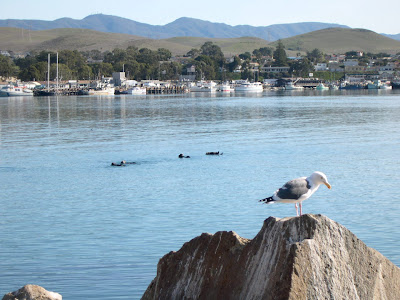
The otters are plentiful here, and you could spend hours just watching them. They dive down and pick up rocks on the bottom, grab a tasty shellfish or clam, and bring it back to te surface. Then they flip onto their back, sit the rock down on top of their stomach, and crack open the shell so they can get at breakfast.
Sea Otters have the thickest and warmest fur of any sea mammal, and for that reason were almost hinted to extinction until they were protected. They are making a comeback, but even today there are less than 3,000 of these animals on the California coast.
Here's a link to check them out:
www.defenders.org/wildlife_and_habitat/wildlife/sea_otter.php
(Yes, we know we need a better camera with a good telephoto lens, and as soon as the bills are paid, it's on our list!)
We found a reasonably-priced room looking over the water, an expensive but tasty Italian dinner, and the next morning lucked into meeting Bob Eiseberg. Bob apparently works for a living driving heavy equipment, but his love is obviously tracking the rare and wonderful Peregrine falcons that nest and play around Morro Rock.
We found Bob standing by his truck, and telescope, enjoying the morning sun and a cup of coffee. He was a wonderful and willing source of information about the wildlife along this part of the California coast.

Bob apparently spends a lot of his time in the parking lot on the south side of Morro Rock, helping people like us, and sharing his telescope.

Shortly after we left him several school groups came in busloads, and the teachers were "looking for Bob."
He told us about two nesting pairs of falcons that live high up on the rock. Showed us through his telescope the a male on the butcher block (dining table) where it devours its prey. Showed us the female on a nearby rock, and discussed the mating and nesting habits.
Here's a bad picture of the nest area:

And a borrowed picture so you can see this beautiful bird:

Peregrine falcons are the fastest birds in the world, they fly up to 200 miles an hour to capture their flying prey on the wing, and we almost killed them all with DDT and other habitat impacts in the mid-1900's. But thanks to the Endangered Species Act, and the resilience of the birds, there are now more than a thousand in the U.S. and Canada. Oddly enough, or maybe not, they have adapted to urban environments and some pairs roost in big city skyscraper window ledges.
But here at Morro Rock, they can find the sort of cliffs and plentiful smaller birds, that make this a more natural home.
You can check out more information about these birds at the following link:
www.defenders.org/wildlife_and_habitat/wildlife/peregrine_falcon.php
While we were there we walked around the base of the rock to the ocean side,

and checked the tide pools,

and then watched a family of sea otters playing and having breakfast of shellfish.

The otters are plentiful here, and you could spend hours just watching them. They dive down and pick up rocks on the bottom, grab a tasty shellfish or clam, and bring it back to te surface. Then they flip onto their back, sit the rock down on top of their stomach, and crack open the shell so they can get at breakfast.
Sea Otters have the thickest and warmest fur of any sea mammal, and for that reason were almost hinted to extinction until they were protected. They are making a comeback, but even today there are less than 3,000 of these animals on the California coast.
Here's a link to check them out:
www.defenders.org/wildlife_and_habitat/wildlife/sea_otter.php
(Yes, we know we need a better camera with a good telephoto lens, and as soon as the bills are paid, it's on our list!)
Subscribe to:
Posts (Atom)